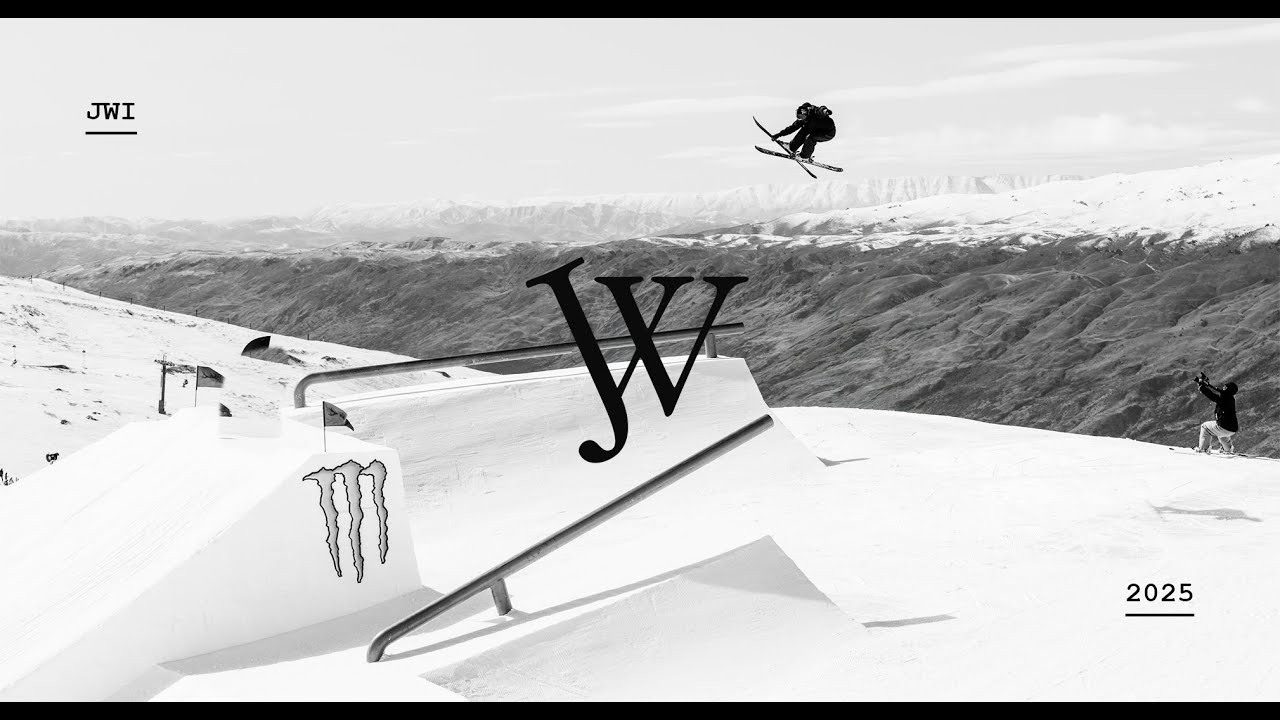
Luca Harrington
Wānaka, New Zealand | Active: FIS status active | Discipline: freeski big air and slopestyle | Verified: 2026 Olympic slopestyle bronze, 2025 Big Air World Champion, 2025 FIS Big Air Crystal Globe, X Games Aspen slopestyle golds | Current: New Zealand Olympic freeski team, Monster Energy athlete
Livigno When The Last Run Had To Hold
Livigno Snow Park sat under flat Alpine light, the rails dulled by repeated edges and the jump landings blending into pale Italian snow. Luca Harrington dropped into his third run in ninth, with one chance left to make the Olympic final answer back.
The run had to be complete, not decorative. He attacked the rail section, carried enough speed into the jump line, landed an 1800, stomped a triple cork 1620, then finished with a clean 1440 on the final jump. The judges gave him 85.15. Birk Ruud won gold with 86.28, Alex Hall took silver with 85.75, and Harrington waited through the remaining riders until bronze became real. New Zealand had another Olympic freeski medal, and Harrington had turned a pressure run into the clearest proof of his senior status.
From Alternate Bib To Aspen Gold
The Olympic medal did not arrive from nowhere. One year earlier, Harrington’s breakthrough at X Games Aspen 2025 came in the strangest possible way. Tormod Frostad withdrew after breaking his arm in Knuckle Huck, leaving a late slopestyle opening. Harrington entered from the alternate list and immediately changed the shape of the contest.
The Aspen course was severe: technical rails, enormous jumps, and enough line choice to punish hesitation. Downdays described Harrington’s first run as including a three swap, back swap, front 270 on the rainbow-to-down tube, followed by a switch triple 1620 on the money booter. That was not a cautious substitute line. It was the kind of run that forced the invited field to chase.
He won slopestyle gold at his X Games debut, then added Big Air silver the same weekend. X Games later framed the result as a breakout rookie performance: alternate call-up, slopestyle gold, big air silver, then confirmation through a world title and Crystal Globe. Aspen turned Harrington from a promising Wānaka skier into an international reference within two days.
Cardrona Before The World Noticed
Harrington grew up in Wānaka, where Cardrona Alpine Resort sits above the valley with one of the Southern Hemisphere’s strongest park setups. Snow Sports NZ records that he learned to ski very young in a family of avid freeskiers and entered his first FIS event at Cardrona when he was fourteen.
That base matters because Cardrona is not only a hometown hill. It is a World Cup venue, a southern-winter training hub, and a place where New Zealand riders can ski serious park and pipe terrain while the northern hemisphere is off-season. For a young skier, that means repetition on rails, jumps, airbags, halfpipe walls, and contest courses without leaving the local system too early.
The Harrington family also belongs inside the story. X Games notes that his older brother Ben is a SuperPipe competitor and that their parents, Greg and Nancy, were former American mogul skiers featured in Warren Miller films. Luca’s pathway was not accidental. It came from a house where skiing was a language before it became a career.
Leysin Bronze Before The Event Switch
The first major podium came at the 2020 Youth Olympic Winter Games in Leysin, Switzerland. Harrington took bronze in freeski halfpipe, a detail that still matters even though his senior identity now lives in big air and slopestyle.
Halfpipe gives a different education. It forces wall timing, edge pressure, amplitude control, body awareness, and the ability to land high enough on transition to keep speed alive. Those skills can disappear in a big-air biography, but Harrington’s early pipe result shows why he later looked comfortable in multiple freeski disciplines.
After Leysin, the competitive route moved through North American Cup, European Cup, Australia New Zealand Cup, World Cup starts, and full senior fields. Snow Sports NZ notes that he chose to focus on slopestyle and big air through the next years. That shift gave him the right stage for his best traits: high rotation, creative rails, switch takeoffs, and heavy landings under pressure.
Bakuriani Fifth And The First Senior Signal
Before the 2025 explosion, Harrington had already left a senior mark at the 2023 World Championships in Bakuriani, Georgia. Snow Sports NZ records that he matched New Zealand’s best freeski big air World Championships result with fifth place, then followed it weeks later with a third-place finish at the Silvaplana Slopestyle World Cup.
Bakuriani was useful because it tested him outside the Southern Hemisphere and outside the X Games spotlight. The Georgian venue brought Caucasus weather, championship pressure, and a field where one-jump execution had to survive qualification and final formats. A fifth-place finish in big air showed that his ceiling was not limited to junior results.
Silvaplana gave the next proof. The Corvatsch course is long, high, and technical, with spring snow that can shift between fast morning surfaces and softer afternoon landings. A World Cup slopestyle podium there carries weight because it asks for complete-course skiing, not just one heavy trick.
How Harrington Builds The Trick Before Takeoff
Harrington’s skiing is built around difficult entry points. His rail work can start with three swaps, back swaps, front 270s, switch entries, and continuing rotations before the jumps even begin. That matters because modern slopestyle judges no longer treat rails as decoration. The top of the course has to score.
His air vocabulary is already among the heaviest in men’s freeskiing: switch triple 1620, switch triple 1800 Esco grab, right triple cork 1980 safety, triple cork 2160 tailgrab, double 1080 bringback to 900 Japan, 1440s, and switch-heavy big air combinations. The numbers are large, but the key is how he sets them up.
Compared with Alex Hall, Harrington is less puzzle-like through transitions and more explosive through the jump line. Compared with Mac Forehand, he has a rawer rail personality and more visible risk in the takeoff choices. Compared with Birk Ruud, he looks less polished in presentation, but his peak difficulty can force the field into dangerous territory fast.
Tignes And New Zealand’s First Freeski Globe
The 2025 Big Air World Cup season made Harrington’s rise measurable. Adventure Magazine reported that he won New Zealand’s first FIS Freeski Crystal Globe by finishing as the top athlete on the 2025 Big Air World Cup Tour. Across five Big Air World Cups, he reached four podiums: two wins, one second, one third, plus a fourth place in Beijing.
The final stop in Tignes gave the globe its sharpest scene. Harrington finished third with 187.00, behind Miro Tabanelli and Mac Forehand, and still locked the season title. His run included a never-been-done switch right triple corked 1800 with an Esco grab and a right triple corked 1980 safety grab.
Tignes is a hard place to close a title. The French Alps venue can bring spring glare, wind, icy takeoffs, and a crowd pressed close to a scaffolded big-air environment. Harrington needed enough points to protect the standings, but he did not ski like a rider only managing arithmetic. He used the final to show why the globe was his.
St. Moritz With The Win Already Safe
Two weeks after the globe, Harrington won the 2025 FIS Freeski Big Air World Championship in St. Moritz/Engadin. FIS official results list him first with 192.00, ahead of Elias Syrjä on 184.25 and Birk Ruud on 183.00. Mac Forehand, Troy Podmilsak, Alex Hall, Ben Barclay, Matias Roche, Timothé Sivignon, and Andri Ragettli completed the final order.
The score tells only part of the story. Harrington had already done enough to win before his third run, then added 95.25 to underline the title. Winning after the title is effectively secured says something about the competitive brain. He was not defending a lead by shrinking the trick.
St. Moritz also changed the New Zealand record. Snow Sports NZ and local reports framed him as the first Kiwi to win the FIS Freeski Big Air World Championship title. That placed Harrington beside a wider New Zealand snow-sports wave: Nico Porteous in halfpipe, Zoi Sadowski-Synnott in snowboard, Ben Harrington in pipe, Finn Bilous moving toward freeride, and a Wānaka/Cardrona scene exporting real medal pressure.
Ben Harrington And The Wānaka Crew Thread
Luca’s older brother Ben is part of the same freeski ecosystem. X Games notes Ben as an X Games SuperPipe competitor and describes the emotional finish-area moment when Luca won at Aspen. That matters because elite skiing often looks individual on television, while the real progression happens through siblings, training partners, coaches, and local crews.
Wānaka has become one of the densest small-town snow-sports hubs in the world. Cardrona gives park and pipe infrastructure. Treble Cone adds freeride terrain. The town connects Olympians, freeriders, snowboarders, coaches, physios, filmers, and families who treat southern winter as serious preparation rather than off-season novelty.
Harrington’s rise fits that environment. He did not arrive as a lone New Zealand outlier. He came through a scene where the reference points include Jossi Wells, Nico Porteous, Zoi Sadowski-Synnott, Finn Bilous, Ben Barclay, Ben Harrington, and a generation that expects New Zealand riders to contest medals rather than celebrate finals alone.
Monster, Cardrona, And The Support Around Progression
Monster Energy presents Harrington as a New Zealand freeskier from Wānaka, raised on Cardrona’s slopes, with Jossi Wells as a stylistic inspiration. The brand also connects him to the Monster Army program before his senior results exploded, placing his development inside a support structure rather than only a national-team story.
That sponsor context is relevant because Harrington’s trick list is expensive to maintain. Switch triple 1800s, triple cork 2160s, and high-risk rail entries require training access, travel, coaching, medical support, and enough competitive starts to test the tricks under pressure. They also require partners willing to support progression before the safest result appears.
His public profile is still more competition-focused than film-focused. Unlike a pure creative skier, Harrington’s current value sits in podiums, start lists, and trick advancement at the highest event level. The footage, however, should still be selected carefully: Cardrona training clips for roots, Aspen for breakthrough, Tignes for the globe, St. Moritz for the title, and Livigno for Olympic pressure.
Active Status After The Olympic Bronze
FIS lists Harrington as active, with New Zealand nationality, FIS Code 2534919, and birthdate February 19, 2004. That active status matters. He is not a legacy page or a completed-career profile. He is twenty-two, already an Olympic medalist, X Games winner, world champion, Crystal Globe winner, and one of the most dangerous big-air skiers in the field.
The next question is not abstract potential. It is event-specific. Can he turn big-air dominance into repeat Olympic pressure? Can his rail sections keep pace with skiers such as Hall, Forehand, Ruud, Podmilsak, Ragettli, Frostad, and Barclay across full slopestyle seasons? Can he keep landing tricks that bend judging expectations without losing his knees, speed, or timing?
For skipowd.tv, the watch order is clear: Leysin 2020 for the halfpipe foundation, Bakuriani 2023 for the senior signal, Silvaplana for the first slopestyle World Cup podium, Aspen 2025 for the alternate-to-gold shock, Tignes 2025 for the first Kiwi freeski globe, St. Moritz 2025 for the world title, Aspen 2026 for confirmation, and Livigno 2026 for the Olympic bronze that made the rise permanent.