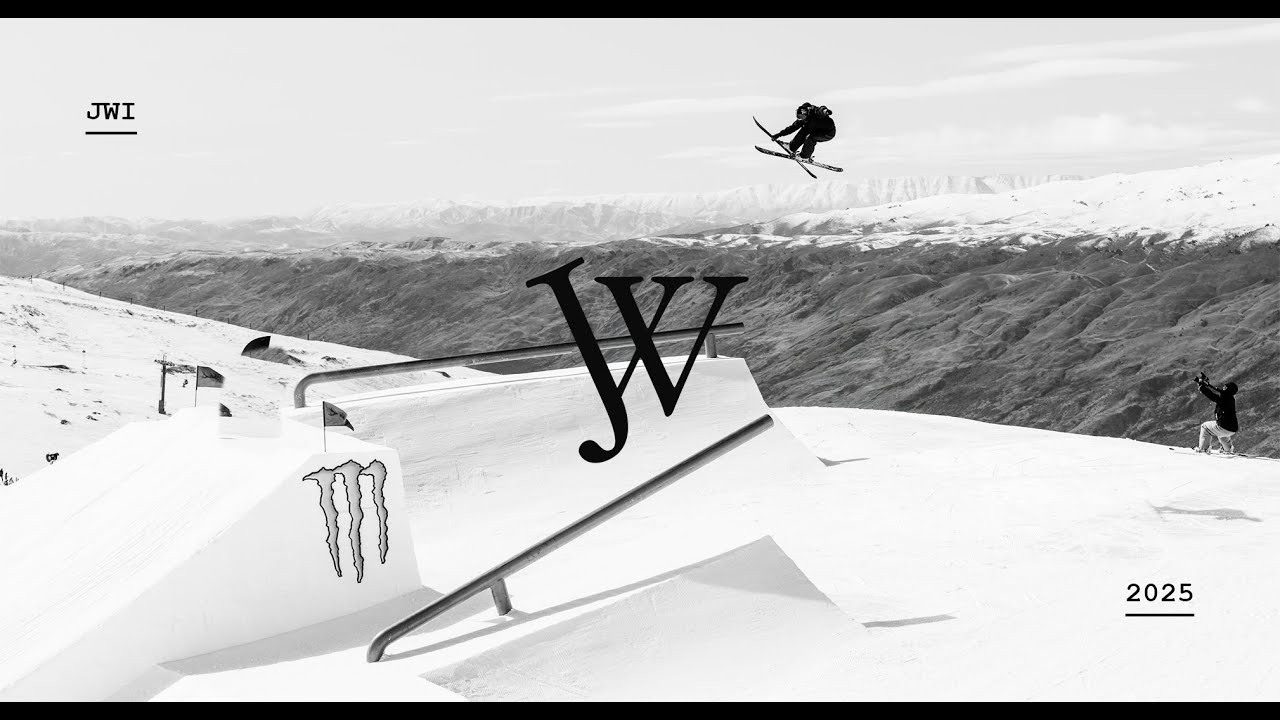
Fin Melville Ives
Wānaka, New Zealand | Active: 2021-present elite halfpipe | Discipline: Freeski Halfpipe, with slopestyle and big air background | Known for: 2025 World Championship gold, X Games Aspen 2026 gold, 2025-26 Crystal Globe
Engadin When The First Run Ended The Argument
The halfpipe in Engadin looked clean under Swiss spring light, its blue lines cutting the walls while the men’s final waited for a teenager from Wānaka to blink. Fin Melville Ives dropped in first and did not need a second run. The amplitude came early, the rotations stayed calm, and the landings sat high enough on the transition to keep speed alive. His score was 96.00. Nick Goepper answered with 94.00, Alex Ferreira with 92.50. Neither caught him. At 18, in his debut senior World Championships, Melville Ives had become New Zealand’s freeski halfpipe world champion.
Wānaka Twins And The Cardrona Household
Melville Ives was born on July 6, 2006, in Dunedin and raised in Wānaka, the South Island town that has become New Zealand’s winter-sports engine. His parents worked as snowboard instructors at Cardrona Alpine Resort, and snow was not a seasonal novelty in the family. It was the family language. Fin and his twin brother Campbell grew up inside it, then split into different lanes: Fin on freeski, Campbell on snowboard.
That split gives the story its texture. Campbell followed the snowboard route that fit the family background, while Fin chose skiing and turned the halfpipe into his main canvas. Both brothers wore the New Zealand fern at Gangwon 2024, then moved toward Milano Cortina 2026 with the unusual pressure of being twins in different pipe disciplines. Their rise also showed the cost of New Zealand snow sports: huge travel, North American and European contest seasons, and a home base far from most major halfpipe venues.
Gangwon Silver Before The Senior Explosion
The first global marker came at the 2024 Winter Youth Olympic Games in Gangwon. Melville Ives qualified first in men’s freeski halfpipe with 92.00, then took silver in the final with 92.50. That result mattered because Youth Olympics halfpipe is not a simple junior exhibition. It is often the first sign of who can turn amplitude, grab discipline and rotation control into a judged run under international pressure.
He also entered slopestyle at Gangwon, finishing 23rd in qualification, a reminder that his public future was already narrowing toward the pipe. The halfpipe suited him better. It gave him repeated walls, a rhythm he could build through five hits, and space to combine height with style. Gangwon did not make him a finished senior athlete, but it placed him on the map one year before the results came almost too quickly.
Calgary And The Fourth-Place Warrior Break
Early in 2025, Melville Ives won his first World Cup halfpipe in Calgary. Reuters later described him as having beaten Nick Goepper and Alex Ferreira there, two Americans with Olympic medals and long pipe histories. That result changed how the field had to read him. He was no longer the Youth Olympic silver medalist with promise. He was beating established names in a senior final.
The Calgary win also arrived after a shift in daily life. No longer carrying the same school load, he could focus more completely on training and contest preparation. Murray Buchan, Snow Sports New Zealand’s national freeski coach and a former Olympic freestyle skier, was part of the support structure around that rise. The run itself was described as a technical sequence of flips and rotations planned long before it landed under World Cup pressure.
Engadin Gold Against Goepper And Ferreira
The 2025 World Championships in St. Moritz / Engadin turned the Calgary breakthrough into a title. Melville Ives scored 96.00 on run one and did not need to improve. Goepper took silver on 94.00, Ferreira bronze on 92.50, David Wise finished fifth, and the final became a rare moment where three generations of men’s halfpipe were visible in one result sheet.
The field context matters. Goepper had moved from slopestyle Olympic medals into halfpipe with serious force. Ferreira was a halfpipe Olympic medalist and one of the most consistent pipe competitors of the previous decade. Wise carried two Olympic halfpipe gold medals in his career. Melville Ives beat them not with a novelty run, but with height, technical control, clean grabs and enough maturity to make the first attempt stand as the final answer.
Aspen 2026 And The SuperPipe Gold
X Games Aspen 2026 gave Melville Ives the medal that moved his profile from major prospect to global name. One year earlier, he had finished fourth at X Games Aspen 2025. In 2026, he won Monster Energy Men’s Ski SuperPipe with 95.00, adding X Games gold to the world title he had taken in Switzerland.
The Aspen win mattered because X Games is not just another halfpipe start. It is the sport’s most recognizable broadcast stage, with a smaller field and less room for a quiet result. Melville Ives came into the event with attention already on him, then landed the run that made New Zealand’s winter-sports week even bigger. The score also fit the pattern forming around him: when his run lands clean, the ceiling is not podium level. It is winning level.
How Fin Builds Height Into Control
Melville Ives’ halfpipe identity starts with amplitude. The height gives the run its first impression, but height alone does not win world titles. He carries speed high on the wall, keeps his grabs visible, and lands far enough down the transition to avoid killing momentum before the next hit. That rhythm is the key. A pipe run is a chain; one low landing can pull the rest of the run apart.
His technical vocabulary includes double cork rotations, alley-oop direction changes, switch takeoffs, rightside and leftside spins, mute and tail-style grab positions, amplitude management, transition landings and pipe-wall speed. The strongest part of his skiing is how young it does not look when the run is working. He can throw modern difficulty without losing the classic pipe shape: pop, hold, spot, land, reset, and repeat.
Murray Buchan And The New Zealand Pipe System
Melville Ives’ rise also says something about New Zealand’s park-and-pipe system. Snow Sports New Zealand has built depth across halfpipe, slopestyle and big air, with athletes such as Nico Porteous, Ben Harrington, Luke Harrold, Luca Harrington, Campbell Melville Ives and Fin himself showing how concentrated the Wānaka and Cardrona ecosystem has become.
Murray Buchan’s coaching role gives the halfpipe story a specific anchor. As national freeski coach, he has worked with young pipe talents during the same period that Melville Ives and Luke Harrold reached major international results. For a New Zealand skier, training also requires long northern trips: Calgary, Aspen, Laax, Engadin, Livigno, Secret Garden and other venues where the pipe size, snow texture and judging expectations can change fast.
Monster, Völkl, Smith And The Current Helmet Line
Public sponsor information around Melville Ives is unusually clear for a skier this young. His athlete and public profiles connect him with Monster Energy, Völkl Skis and Smith Optics. Monster presents him as a New Zealand halfpipe standout built around progression, height and classic style, while Smith lists him on its athlete roster.
The equipment story fits the discipline. Halfpipe skis must hold edge pressure at speed, stay stable through icy walls, release cleanly from the lip and survive heavy transition impacts. Optics matter because flat light can make the pipe wall disappear at the exact moment a skier needs to spot the landing. The sponsor line also places him inside a broader New Zealand action-sports moment, beside snowboard and freeski athletes now scoring medals, globes and world titles across formats.
Livigno And The Olympic Crash
Milano Cortina 2026 was supposed to be the Olympic confirmation. Melville Ives entered the men’s freeski halfpipe as world champion, X Games champion and one of the clearest medal favorites. The qualification day in Livigno became the opposite. He fell on both runs, with the second crash severe enough that medical teams stretchered him from the pipe after a head impact and leg concern.
The result was cruel because it ended the Olympic bid before the final. Reuters reported that he was conscious and undergoing medical checks, while teammate Ben Harrington dedicated his own qualification run to him. Gus Kenworthy called him the best pipe skier in the world at that moment and said he expected him to come back. For this biography, the crash should not be written as a failure. It is a factual turning point in a season that had already produced world, X Games and World Cup dominance.
The Crystal Globe After The Crash
The 2025-26 season did not end with only the Livigno image. After wins and podiums across the World Cup halfpipe campaign, Melville Ives earned the men’s Freeski Halfpipe Crystal Globe. That trophy matters because it rewards season-long performance rather than one final. It placed him at the top of the World Cup halfpipe standings even after the Olympic crash interrupted the most visible event of the year.
That is why his importance reaches 5/5 despite his age. Melville Ives has Youth Olympic silver, a senior World Championship title, X Games gold, multiple World Cup wins, the halfpipe Crystal Globe and an Olympic story that is already unfinished rather than closed. The next factual checkpoint will be his return to full competition after Livigno. The standard is now set: when Fin Melville Ives drops into a clean pipe, the field has to answer a world-champion score.