Oliver karlberg
Falköping / Kläppen, Sweden | Active: 2013-present public record | Known for: SuperUnknown XIV, Level 1 films, Airea, The Bunch Color, Suéde street projects | Current: Suéde / Movement Skis-linked street skier
Sierra Cement Before The Vote
The landing at Sierra-at-Tahoe was heavy with wet spring snow, the kind that steals speed and makes every mistake stop dead. Oliver Karlberg still sent the windlip bigger than anyone in the SuperUnknown XIV finals week, then carried that same looseness into rails, tree jibs and strange features. By the final vote, the Swedish skier who had arrived as a true unknown had become the name almost everyone wrote down. That 2017 win did not turn him into a contest skier. It opened the door to the film world where his skiing already made more sense: street, odd terrain, clean grabs, blunt pressure and Scandinavian crews.
Falköping Roots And Kläppen Repetition
Karlberg was born in 1996 in Falköping, a small town in southern Sweden, and has described Kläppen as the resort where he skied the most during his early adult years. That background fits the way his skiing developed. Kläppen does not need to be dressed up as a giant mountain. Its value is repetition: park laps, rails, side hits, small jumps, rope rhythm, changing snow speed and friends pushing each other through the same features until style becomes visible. The FIS record is brief but confirms the competitive layer around that period, including a Swedish FIS slopestyle win at Tandådalen in April 2017.
The SuperUnknown Week That Changed The Map
SuperUnknown XIV placed Karlberg in a finalist group with Aleksi Patja, Siver Voll, Rory Walsh, Miika Virkki, Ben Zins, Vince Prevost, Chase Mohrman, Simon Bartik and Zach Masi. The week at Sierra-at-Tahoe was not a standard slopestyle contest. It was a filmed pressure cooker: windlip booters, custom rails, quarterpipe-tree jibs, sidecountry sessions and peer voting. Newschoolers described Karlberg’s win as close to unanimous, with his size contrasted against how big he went. The traits that carried the week were clear: clean style, capped blunts, humility, creative trick choice and the ability to make awkward features look planned.
Habit And The Level 1 Door
Winning SuperUnknown gave Karlberg an immediate route into Level 1’s film world. Habit, released in 2017, listed him among a cast with Keegan Kilbride, Laurent De Martin, Sämi Ortlieb, Wiley Miller, Will Wesson, Khai Krepela, LJ Strenio, Rob Heule, McRae Williams, Noah Albaladejo and others. The film was shot across Iceland, Russia, Finland, British Columbia, Mammoth, Winter Park, Sunshine Village, Alaska, Colorado, Michigan, New York and Utah. For Karlberg, the key was not simply appearing in a major movie. It was entering a production language where street and park could sit beside travel, powder and hard urban missions.
Airea Within One Hour Of Älvdalen
Airea gave Karlberg a more personal Swedish statement. The Armada project with Kim Boberg was filmed around Älvdalen and Kläppen, with every location kept within about one hour’s drive. That constraint shaped the film. Instead of chasing an exotic destination, Karlberg and Boberg treated nearby terrain as enough: small-town streets, Swedish snow, local park features, low-key backcountry pockets and setups that demanded invention rather than scale. The skier list also connected him to Hugo Burvall, Freddie Grann, Phil Casabon and Yohei Maruyama, while the direction credits included Fredrik Larsson, Kim Boberg and Karlberg himself.
Zig Zag And The Sweden Opening
Level 1’s Zig Zag in 2018 placed Karlberg in one of the strongest casts of that era, with Parker White, Laurent De Martin, Sämi Ortlieb, Chris Logan, Will Wesson, Keegan Kilbride, Thayne Rich, Kim Boberg, Tanner Rainville, Ahmet Dadali and others. The film opened with a Swedish segment featuring Peyben Hägglund, Kim Boberg and Karlberg, giving his skiing a hard street frame rather than a novelty follow-up to SuperUnknown. The locations around Zig Zag stretched from Sweden and Helsinki to Hokkaido, Moscow, Whistler, Montana, Michigan and Minnesota, but Karlberg’s strongest signal remained close to home: Scandinavian street with heavy consequences and precise body language.
Color With The Bunch In Russia And Sweden
The Bunch’s Color widened the crew map again. The film was built mostly in the streets of Russia, with trips to Sweden and Japan, and listed Karlberg alongside Peyben, Alex Hackel, Kim Boberg, Magnus Granér, Lucas Stål Madison, Forster Meeks, Lauri Kivari and Hugo Burvall. That context is important because The Bunch had already changed how freeskiers understood street skiing. The crew valued rhythm, absurdity, looseness, editing, clothing, music and the strange beauty of a trick that might not read like a conventional banger. Karlberg fit that language because his skiing could be technical without becoming stiff.
Suéde And The Crew After The First Breakthrough
Karlberg’s later public identity sits strongly with Suéde, the Swedish crew orbit that includes Hugo Burvall, Siver Voll, Joel Magnusson, Benjamin Carlund, Jonathan Eklund, Vilmer Ivarsson and other riders depending on the project. What’s for Breakfast? was filmed in Sundsvall, Stockholm and Helsinki, with Karlberg in the skier list and a tone that mixed long rails, classic technical street skiing and a fresh approach to features. The film’s thanks list reached into the same loose ecosystem: Child Labor, Jetskis, Armada, Lead Fabrics, Movement, Capeesh and friends who helped the crew turn northern cities into ski spots.
Wonderfuel Between Riksgränsen And The Streets
Wonderfuel showed Suéde’s wider range. The film moved through Riksgränsen backcountry, Kimbo Sessions and Swedish street, with riders such as Magnus Granér, Daniel Bacher, Matěj Švancer, Henrik Harlaut, Remco Kayser and Karlberg. That mix helps explain his position in modern freeskiing. He can belong in a pure street crew, but he is also part of the Swedish style network that connects backcountry booters, spring park sessions, rider-led events and city rails. In that world, the line between skier, producer, filmer and friend is thinner than in traditional competition skiing.
Exciety Threshold And The Street Film Made Sharper
Exciety Threshold, released by Suéde in late 2024, is one of Karlberg’s strongest recent markers. The film features Hugo Burvall, Oliver Karlberg, Siver Voll and Aleksi Patja, with Movement Skis presenting the project. Karlberg and Burvall are credited as producers, Emil Larsson filmed, Björn Eklund edited, and Martin Axéll contributed stills and extra filming. The result placed Karlberg inside a current street-skiing conversation rather than an archive. He is not only remembered as the 2017 SuperUnknown winner. He is still helping produce the kind of films that younger street skiers study.
Blunts, Disasters And Calm Speed
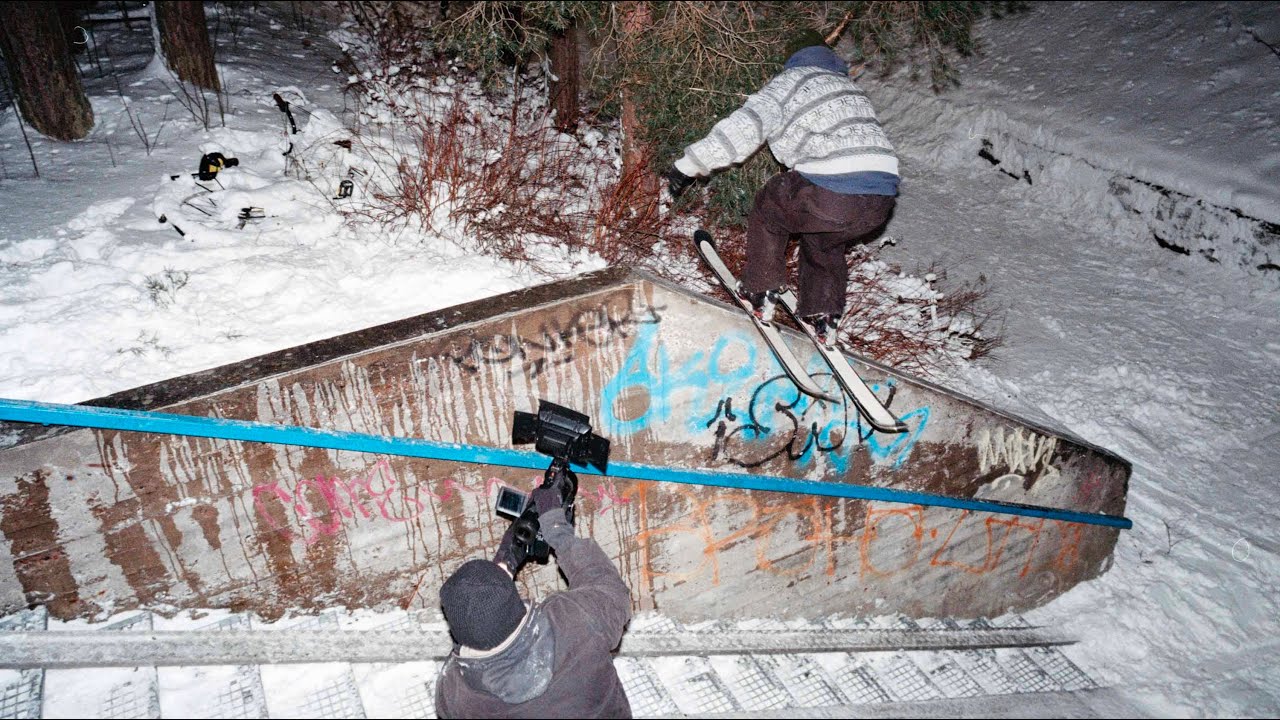
Karlberg’s technique is built around contrast. He often skis large or dangerous features without looking hurried, using quiet shoulders, centered hips, strong rail pressure and controlled exits. The SuperUnknown recaps pointed to capped blunts and big airs. Later street films add disasters, wall contact, long rails, low-speed approaches, redirected landings, switch entries and features where the run-in looks almost too short. His skiing does not chase maximum spin count first. It usually starts with the object itself: how to enter it, where to hold pressure, when to release, and how to make the after-movement feel natural.
The Current Karlberg Lane
Oliver Karlberg’s verified profile is creative, film-heavy and culturally specific. The official FIS trail is short, but the video archive is strong: SuperUnknown XIV winner, Level 1’s Habit and Zig Zag, Armada’s Airea, The Bunch’s Color, Suéde’s Wonderfuel, What’s for Breakfast? and Exciety Threshold, plus Movement-linked projects around the current street scene. His lane is Swedish street skiing with a global audience: Falköping roots, Kläppen repetition, Sierra-at-Tahoe breakthrough, Scandinavian crews, and a style that makes difficult features feel almost casual until the replay shows how much control was required.