Mark Abma
British Columbia, Canada | Active public film record: 2003-present | Known for: MSP film parts, Powder Video Awards, Salomon Freeski TV, Warren Miller appearances, big-mountain style, sustainability work | Current: Squamish-based skier and Outdoor Research athlete
Coast Mountains When The Spine Opened
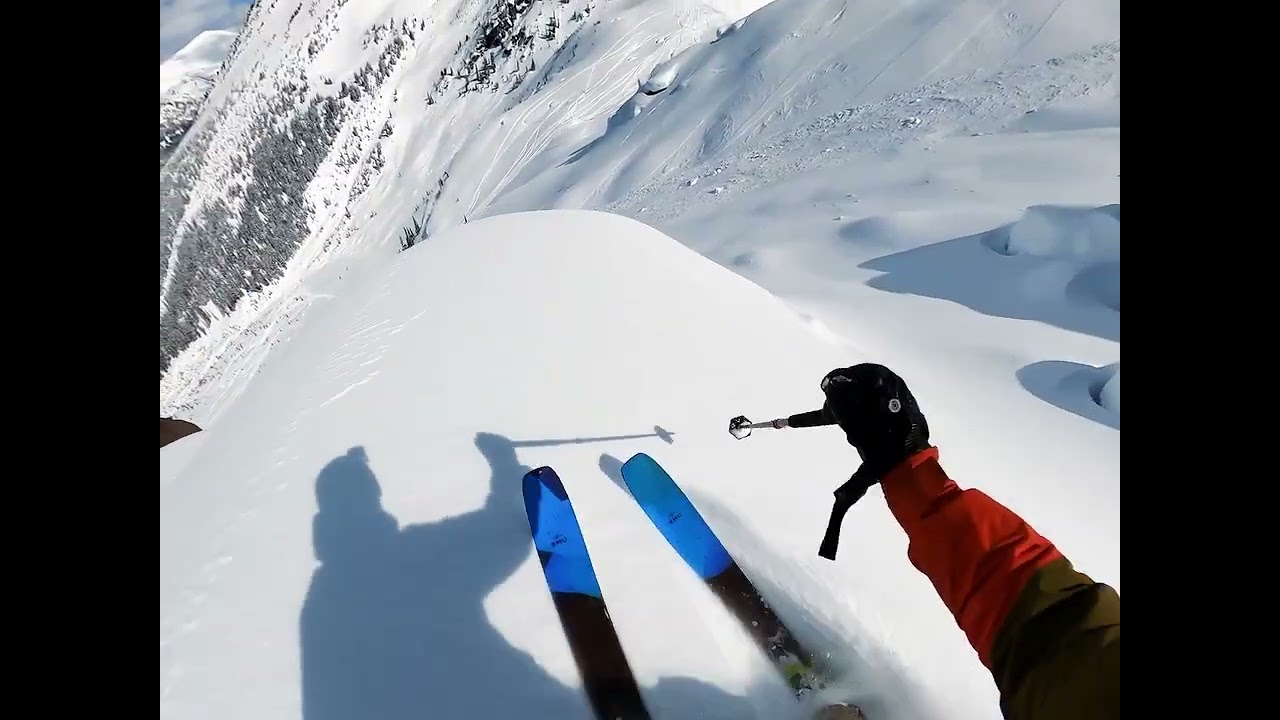
The Coast Mountains were grey at the ridge, with wind moving loose snow across the rollovers before Mark Abma dropped into the face. His skis cut from the crown into the fall line, then released into a slash that looked loose without losing speed. That balance became his signature. Abma did not bring park skiing into the backcountry as a costume. He brought timing, air sense, and body position into terrain where every landing had texture. His influence sits in that conversion: moguls to park, park to film, film to big mountain, and big mountain to a style that younger skiers still study.
Hemlock Valley Before The Whistler Move
Abma’s public origin runs through British Columbia rather than a national-team legend. Warren Miller lists Pemberton as his hometown, Hemlock Valley as the mountain where he learned, and Whistler as his favorite mountain. Other profiles connect the early story to Langley, Sasquatch Mountain, and the move toward Whistler as a teenager. That path matters because Abma’s skiing never looked like it came from one lane. Moguls gave him absorption and rhythm. Park gave him rotational confidence and takeoff instinct. Whistler and the Coast Mountains gave him pillows, spines, storm snow, and the scale required for a film career.
Ready, Aim, Fire And The 2003 Door
The screen record starts in 2003, when Abma appeared in Poor Boyz Productions’ Ready, Aim, Fire. Newschoolers describes that debut as the beginning of a career that still has him clipping more than two decades later. The timing was perfect for a skier with his mix. Freeskiing was moving fast: park competitions were growing, film companies were expanding, and backcountry segments were becoming the strongest currency in the sport. Abma stepped into that moment with a style that could handle a step-down, a natural 360, a powder landing, and a steep line without feeling split between disciplines.
Bella Coola And The Yearbook Shock
Yearbook in 2004 remains one of the key Abma reference points, especially because it showed a skier crossing from freestyle promise into big-line authority. His Bella Coola footage helped establish that he was not only a park skier searching for deeper landings. The terrain demanded inspection, sluff management, fast turns above exposure, and the ability to keep composure between features. That segment later carried Powder Video Awards weight, and Protect Our Winters Canada lists him as Best Male Performance winner in 2005. For Abma’s biography, this is the first hinge: the moment where a new backcountry identity became public.
Push, Powder Awards, And The MSP Core
Push, released by Matchstick Productions in 2006, gave Abma another defining award cycle. Protect Our Winters Canada confirms his second Powder Video Awards Best Male Performance honor in 2007, placing him in a rare film-performance category rather than a contest ranking. That distinction fits his career. Abma’s strongest competitive platform was not a start gate. It was the full winter film part, where one skier had to collect enough footage across storms, flights, sled days, heli windows, injuries, and failed missions to tell a season-long story. His work with MSP turned him into one of the company’s central big-mountain faces.
Claim, In Deep, And The Alaska Language
MSP’s Claim in 2008 placed Abma inside a cast that included Ingrid Backstrom, Shane McConkey, Sean Pettit, Eric Hjorleifson, Chris Rubens, TJ Schiller, Kaj Zackrisson, and others. Matchstick’s own description highlights early-season powder with Abma and a return to Alaska over four shoots. That period is crucial because Alaska changed how many viewers understood him. His skiing there was not only about dropping fast into a spine. It was about shaping turns between ribs, entering exposed rollovers without panic, and using freestyle timing on natural airs where no landing was built to forgive him.
Natural Air, Powder Days, And Drop Everything
Abma’s award trail continued through powder-focused segments. Matchstick lists the Drop Everything full powder segment, featuring Abma, Eric Hjorleifson, and Chris Rubens, as the winner of the 2017 Powder Magazine Video Awards for Best Powder. The description says the segment came from the deepest powder day the cameraman had ever seen. That detail matches the visual language of Abma’s later career: less about a single trick, more about moving through deep snow with enough strength to stay centered and enough looseness to let the skis drift. In pillows and trees, that balance is harder than it looks.
How Abma Made Backcountry Freestyle Feel Natural
Abma’s technical identity is built around smooth aggression. He uses fall-line speed, controlled slashes, natural airs, 360s off terrain, stomped pillow exits, steep spine turns, drifted entries, and soft-snow absorption without breaking rhythm. BlackStrap describes him as a park-background skier who brought a fresh perspective to the backcountry. That is the cleanest technical summary. He did not ski big mountains like a racer, and he did not ski them like a park rider ignoring consequence. He joined both ideas: the body quiet above the feet, the skis free enough to smear, and the line chosen with film shape in mind.
Salomon Freeski TV And The Shogun Years
Abma’s Salomon era gave him a product-development and web-video presence beyond MSP. The Shogun in Chile episode of Salomon Freeski TV placed him with Cody Townsend, Kaj Zackrisson, and Laurent Niol in southern Chile for final testing on his bamboo ski, the Shogun. That mission matters because it shows Abma inside the design loop, not just wearing a logo. The ski was tied to powder flow, freeride versatility, and the early push toward more conscious materials. His One Step work from the same period connected sponsors, biodiesel, recycled materials, and ski-resort carbon conversations long before sustainability became a standard athlete-page paragraph.
Days Of My Youth And The Modern Cast
Days of My Youth in 2014 placed Abma in a Red Bull Media House and MSP project with Richard Permin, Michelle Parker, Bobby Brown, James Heim, Cody Townsend, Markus Eder, Banks Gilberti, Sam Anthamatten, and Sander Hadley. The film was built around a wider question than trick progression: why skiers keep returning to mountains through risk, travel, joy, and obsession. Abma fit that cast because his career already carried time. He was no longer only the explosive skier from early MSP segments. He had become a bridge between the first freeski-film boom and a newer, more cinematic generation.
Warren Miller, Poor Boyz, And The Wider Archive
Abma’s filmography is not limited to MSP. Protect Our Winters Canada notes appearances in Warren Miller and Poor Boyz productions, while Warren Miller’s own athlete page lists Impact in 2004, Higher Ground in 2005, Ticket to Ride in 2013, Chasing Shadows in 2015, and 75 in 2024. That range is one reason his importance grades higher than a single-company star. Abma’s archive crosses production houses, eras, formats, and audiences. He appears in the old DVD economy, the Salomon web-series era, Red Bull-backed cinema, and modern streaming film tours. The common thread is still snow texture and line feel.
One Step, Gardens, And Carbon Footprints
The off-snow chapter is not decorative. Newschoolers reported in 2009 that Abma created One Step to help skiers and resorts reduce carbon footprints, and the piece described biodiesel work with used cooking oil from Whistler restaurants. Kootenay Mountain Culture later wrote about his Pemberton garden, local food focus, offsets, and the tension between global ski travel and environmental responsibility. That contradiction is part of his real story. Abma’s career depended on helicopters, sleds, flights, storms, and remote ranges. His public response was not silence; it was a practical attempt to make the ski world look at its own habits.
Outdoor Research And The Current Squamish Chapter
Outdoor Research now presents Abma as a Squamish-based skier with more than 20 film features, multiple skier-of-the-year awards, and a role in developing outerwear collections. That current chapter keeps his profile active without pretending he is chasing the same career markers as a 22-year-old World Cup athlete. He is still connected to film, gear, mountain travel, and the Coast Mountains. The physical style has adapted, but the public role is steady: veteran skier, product collaborator, environmental voice, and reference point for athletes who want backcountry footage to feel fluid rather than forced.
The Abma Ledger
Mark Abma is a 5/5 skipowd.tv profile because his record carries awards, longevity, film depth, technical influence, and cultural afterlife. The verified frame is precise: British Columbia roots, Hemlock and Whistler foundations, Poor Boyz debut in 2003, long MSP run, Powder Video Awards, Warren Miller appearances, Salomon Freeski TV, One Step, Outdoor Research, and current Squamish life. His page should close on that evidence: a backcountry skier whose style turned film parts into reference material.