Lalo Rambaud
Annecy / La Clusaz, France | Active: 2018-present | Known for: All On Black, Triangle, Kings & Queens of Corbet’s, FWT Junior and Challenger results | Current: LINE Skis, Mammut, La Clusaz and Smith Optics
Corbet’s With The Takeoff Already Falling Away
Corbet’s Couloir was cut in hard white light, the Jackson Hole crowd tucked below the rock walls, and Lalo Rambaud was already upside down before the landing had fully appeared. His Kings & Queens of Corbet’s runs carried the same energy that has followed him from La Clusaz to Japan, Gressoney, Whistler and Wyoming: freeride skiing treated as movement first, result second. He is not a classic contest-only athlete, nor only a film skier hiding from scorecards. Rambaud’s current profile lives between exposed faces, creative short films, deep snow, big drops, thermal-camera experiments and the loose confidence of a skier who grew up seeing La Clusaz terrain as a playground rather than a stage.
La Clusaz Before The Camera Found Him
Rambaud’s public story is rooted in the French Alps, with Mammut listing Annecy as home and Jackson Hole Mountain Resort describing him as a French athlete who grew up skiing La Clusaz with friends and coach Seb Michaud. That local geography matters. La Clusaz has steep lift-access terrain, playful natural features, forest pockets, wind lips and the Balme sector’s freeride culture close at hand. Rambaud did not need to invent a mountain identity later. He came from a place where young skiers could move from resort laps to freeride lines quickly, learning speed, snow texture, cliff timing, sluff management and the consequences of choosing the wrong entrance.
Junior Start Gates And The First Freeride Markers
The Freeride World Tour Junior record gives the first measurable frame around his rise. In 2019, Rambaud won the Ski Men category at the Eldorado Freeride Junior Vallnord U-18 in Andorra, ahead of Paul Dentan and Abel Moga. That same season, he placed fourth at the French Freeride Junior Chamonix U-18 behind Maxime Chabloz, Manou Maret and Quentin Grandin. In 2020, he won the Châtel Freeride Days Junior U-18 and later finished tenth in Ski Men at the Freeride Junior World Championship in Kappl. Those results show more than promise. They place him inside a strong European junior field before his ski-film identity fully took shape.
Verbier And The Step Out Of Juniors
After the junior phase, Rambaud moved into adult freeride qualification. One of his clearest FWT Qualifier results came at the 2021 Verbier Freeride Week by Dynastar #2, where he won the Ski Men category ahead of Tom Richard and Philipp Koller. The venue matters because Verbier demands line choice, composure and a different kind of patience from junior events. Freeride judging gives one run to combine fluidity, control, air, technique and line selection. Rambaud’s later film skiing often feels free, but the competition record shows he learned to manage judged pressure before the camera projects became central.
Annecy, Management Studies And The Life Around Skiing
Mammut’s athlete profile gives a useful view of Rambaud away from start lists. It lists him as born in 2002, a Mammut athlete since 2018, and based in Annecy. The same profile notes wing foiling as a hidden talent, Victor Daviet as an influence, and the desire to finish a master’s degree while improving at golf and chess. Jackson Hole’s Kings & Queens profile also mentions his management studies and time on the water with foils. These details are not filler. They explain why his ski projects often feel less like standard athlete content and more like personal experiments built around rhythm, risk, travel and visual identity.
Triangle Between Jackson Hole, Gressoney And Balme
Triangle gave Rambaud’s creative direction a sharper public shape. iF3 describes the 2024 film as a three-part project tracing one of his strongest seasons from Jackson Hole to Gressoney and Balme, with Lalo Rambaud and Tucker Carr as athletes and Antonin Rivet handling filming, editing, color grading and sound design. The locations form a clear triangle of influence. Jackson Hole adds cliffs, speed and North American exposure. Gressoney brings Italian alpine snow, storm cycles and freeride faces beneath Monte Rosa. Balme brings the home layer at La Clusaz, where Rambaud’s skiing has the least distance between memory and line choice.
All On Black And The Heat Inside The Image
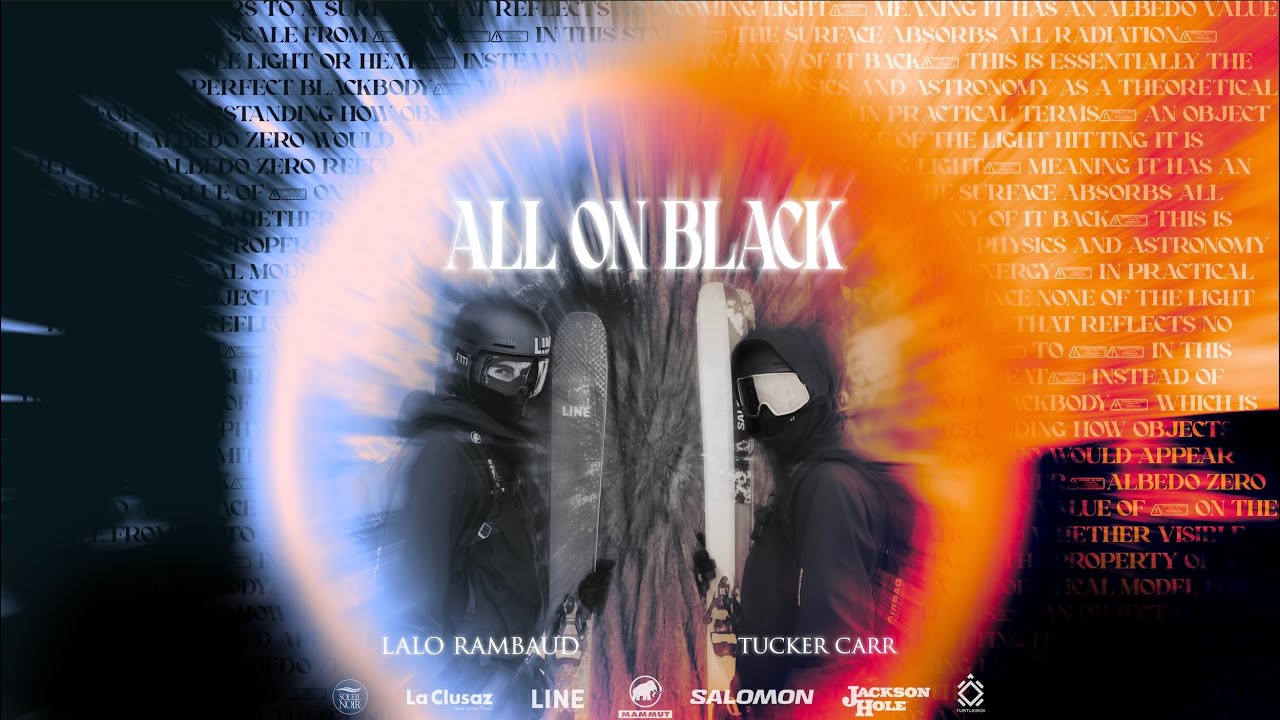
All On Black pushed that visual language further. Teton Gravity Research lists the 2025 short as directed by Tucker Carr and Lalo Rambaud, featuring both skiers and filmed in France, Jackson Hole and Whistler. The project uses thermal-camera effects, heat, fire-like imagery and melting-snow visuals to turn freeride footage into something closer to an art piece than a standard seasonal edit. That approach fits Rambaud’s own Mammut line about skiing as art. In All On Black, the trick is not only the backflip, drop or powder slash. The film asks how the image changes the way the viewer feels the cold, speed and consequence.
LINE France And The Freeride Crew Morning
Rambaud’s place inside LINE’s French crew gives him another lane beyond solo projects. In Daydream, the Keep The Line team built a short around an ideal ski day, beginning with the freeride group of Lalo Rambaud, Romain Lambert and Noah Peizerat heading out at sunrise for couloir descents before the film moves into village street skiing and park laps. That structure suits him. He can belong to a freeride crew without becoming separated from freestyle culture. His skiing uses big-mountain speed, but also the timing of someone comfortable sending backies into powder, shifting off natural features, and treating a face like a line with punctuation rather than only a descent.
Gressoney Powder And The Dolce Vita Detour
LINE’s Dolce Vita project with Lalo Rambaud and Lou Barin adds a softer travel layer. The film followed the French crew into Gressoney, Italy, during a March trip shaped by road and resort closures, deep powder and bluebird windows. That context matters because Rambaud’s skiing is not only about exposure. In Gressoney, the interest sits in storm timing, snow depth, terrain access and the way two skiers move through a place when the plan changes. His strongest footage often keeps that sense of travel intact. A line does not appear by itself. It comes from weather, closure, waiting, approach, and the right amount of luck.
Kings And Queens As A Natural-Feature Test
Kings & Queens of Corbet’s gave Rambaud a different kind of stage. Jackson Hole listed him in the 2025 field as a 22-year-old French athlete from the French Alps, then welcomed him back for 2026, noting his La Clusaz background, steep-pitch comfort, big-air ability and All On Black work with Tucker Carr. Corbet’s is not a FWT face and not a park jump. It is a single iconic entrance where skiers are judged by peers, style, commitment and how they use the couloir’s natural shape. Rambaud’s double-backflip attempts, shifty movement and corked natural-feature skiing fit that strange hybrid: freeride consequence with freestyle timing.
How He Reads A Face Before The Trick
Rambaud’s technique is best understood through the order of decisions. He does not appear to choose tricks first and terrain second. The face sets the rhythm: entrance, snow quality, speed pocket, air, landing, exit. Then the freestyle element enters. That can mean a backflip off a natural lip, a cork seven off a kicker, a stalled-out shifty, a slash through powder or a direct line through broken terrain. His skiing needs edge pressure, air awareness, sluff reading, landing strength, quick speed checks, natural takeoff timing and enough calm to keep style visible when the terrain is not forgiving.
Mammut, LINE, La Clusaz And The Current Frame
The sponsor picture around Rambaud reflects the split nature of his career. Mammut gives him a mountain-safety and freeride identity. LINE Skis connects him to a freeride-freestyle culture that can move from couloirs to park laps without changing language. La Clusaz remains the home-resort anchor, while Smith Optics appears in his recent Kings & Queens listing. His current public record is now coherent: FWT Junior wins, a Verbier Qualifier victory, a Challenger profile, Kings & Queens appearances, Triangle, All On Black, LINE France films and Mammut-backed freeride content. Rambaud’s lane is not defined by one podium. It is defined by the overlap between judged freeride, natural-feature freestyle and ski films that care about how a line looks as much as where it lands.