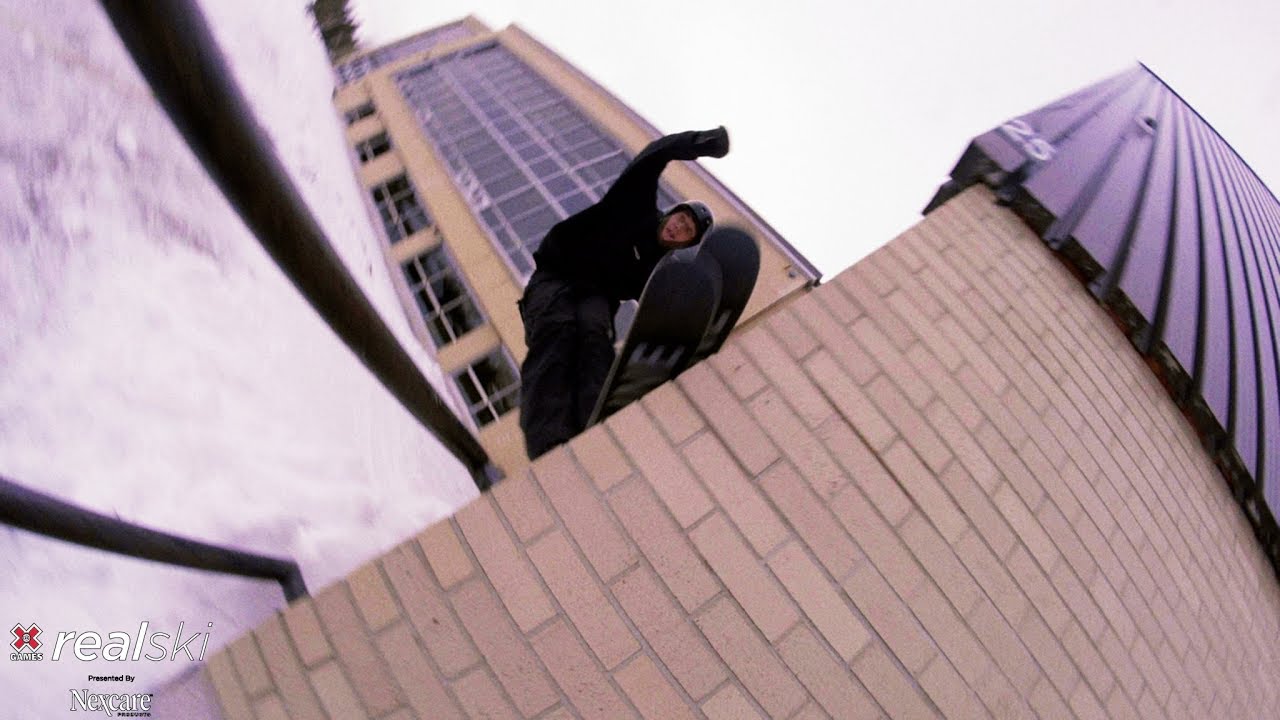
Pär Hägglund
Bollnäs, Sweden | Active: street skiing, filmmaking, product work | Discipline: street skiing, creative park, ski film | Verified: X Games Real Ski 2019 silver, 3x X Games medalist as skier/filmmaker, The Bunch co-founder, 1000 Skis co-founder | Current: 1000 Skis R&D/CX, The Bunch creative circle
Boston Before The Deadline
Boston was still dim at 7:30 a.m., a parking lot glowing after a night of filming. Pär “Peyben” Hägglund, Emil Larsson, Alex Hackel, and Alric Ljunghager gathered around the last clip before an eight-hour drive and a midnight upload.
That Real Ski 2019 push explains Peyben better than a clean sponsor bio could. The project had been built from street spots, snow shovels, failed attempts, and the pressure of sending a ninety-second edit into X Games against Phil Casabon, Henrik Harlaut, Alex Beaulieu-Marchand, Jake Mageau, and Kim Boberg. When the results came back, Casabon won gold, Peyben took silver, and the Swedish skier who had built his name through strange movement suddenly had one of street skiing’s loudest medals.
Bollnäs Before The Park Took Over
Pär Hägglund grew up in Bollnäs, Sweden, in a skiing family. Åka Skidor records that his older sisters were in the alpine club and that Pär himself was on skis as a two-year-old. The earliest track was racing, but racing did not hold him for long.
The telling story comes from an alpine race in Björnrike. He won, but instead of waiting for the prize ceremony, he changed into park skis and left for the features. His father later called to scold him for not showing the other racers respect. The point is not childish rebellion. It shows the split that defined the career: the pleasure of turning existed, but the park gave him a different kind of freedom. Gates had order. Park skiing had possibility.
Kiruna Streets And The Bunch Family
The next key place was Kiruna, far north in Sweden, where midnight sun and northern darkness shape daily life. Hägglund found Rymdgymnasiet there, with slopestyle as part of the school setup. He also found the group that became The Bunch.
Åka Skidor describes that class as a new family: skiers who had moved far from home to combine school and skiing. The park in Kiruna was not always well maintained, so the crew moved away from large jumps and standard rails into the streets. That suited Peyben. He was not the strongest big-jump skier in the group, and trying to copy everyone else did not work. On the ground, on small features, on awkward urban setups, he could invent first.
That discovery shaped The Bunch’s language. The crew did not only ski and hire someone else to document it. They skied, filmed, edited, argued, built, failed, and caught their own tricks on camera. Peyben’s interest in filmmaking grew from that system.
Far Out, Finess, And Finito Made The Weirdness Public
The Bunch’s early films gave Peyben the right environment. Far Out, released in 2013, placed him with Magnus Granér, Leo Björklund, Lucas Stål Madison, Linus Tornberg, and a wider Swedish crew in a film that asked viewers to accept small tricks, odd features, and strange pacing as central material.
Finess followed in 2014 and sharpened the crew’s identity. It was not a normal park movie organized around biggest trick, best jump, and final banger. It used street spots, Scandinavian snow, humor, uncomfortable rhythm, and movements that looked almost too small until the viewer understood the balance involved.
Finito, released in 2015, pushed the same approach further. Newschoolers called attention to how The Bunch did not fit a normal crew definition and quoted Peyben explaining that naming the exact membership missed the point. The Bunch worked because weird people attracted weird people, then skied, filmed, and created together.
Funäsdalen And Peyben In The Park
Peyben in the Park gave his personal style a compact public form. The 2015 edit followed him around Funäsdalen for a few park sessions, with Douglas Källsbo behind the camera. Two years later, Peyben in the Park II returned to the same loose spirit, with more tricks built from butters, presses, drifts, and rail timing.
Those edits matter because they are not large productions trying to inflate the skiing. They work because the skiing is already strange enough. Peyben uses small transitions, flat ground, noses, tails, ski flex, side pressure, and delayed exits like a vocabulary. The trick can begin before the rail, continue while the ski is barely sliding straight, and finish after the viewer expected the move to be over.
Freeskier later framed his movement as a horizontal story in a vertical world. That phrase fits because Peyben often takes a sport obsessed with height and sends the energy sideways.
Level 1 Zig Zag And The Street Performance Line
Peyben’s work also reached beyond The Bunch. His appearance in Level 1’s Zig Zag earned Best Street Performance of the Year at iF3, according to Freeskier. That award is useful because it puts a formal marker beside a style that can otherwise be hard to measure.
Street skiing is not only about finding the tallest rail. The work includes location scouting, shoveling, speed building, police timing, landing construction, filmer placement, and enough tries to make a trick look spontaneous. Peyben’s best street skiing uses all of that invisible labor, then hides it behind a movement that looks loose and playful. The result is deceptive. The skiing feels casual because the preparation has already absorbed the stress.
Real Ski 2019 And The Shovel Hours
The Real Ski 2019 edit was the clearest proof of Peyben’s competitive value as a street skier. Åka Skidor reported that he and Emil Larsson spent exhausting weeks building features, fighting weather, and shoveling huge hours while the psychological pressure rose. The format left no start list comfort: every invited skier was building secretly, and nobody knew how strong the other edits would be.
Newschoolers listed the final result plainly: Phil Casabon gold, Pär “Peyben” Hägglund silver, Alex Beaulieu-Marchand bronze. The judge panel included Tom Wallisch, Mike Hornbeck, LJ Strenio, Josh Berman, and Jeff Schmuck, a group with enough street-ski credibility to make the medal meaningful.
Peyben’s part stood out because almost nothing looked like a stock trick. The skiing used rails, ledges, strange approaches, low-speed control, slow rotations, surface shifts, and body positions that felt half invented on site. It was not technical in the Wallisch sense of perfect symmetry. It was technical because it looked like no one else could have made the same choices.
Behind The Lens With Hackel And Color
Peyben’s importance is not limited to clips of himself. The Mayrand Podcast and Newschoolers both identify him as a three-time X Games medalist: one medal as a skier and two as a filmmaker. His work with Alex Hackel is central to that second role.
X Games Real Ski 2021 listed Alex Hackel’s entry with Pär “Peyben” Hägglund as filmer and editor. That part won silver and confirmed Peyben’s value behind the lens. He understood how to film another skier without flattening their personality. Hackel’s skiing needed space, humor, timing, and camera choices that let the trick breathe. Peyben could supply that because he had lived the same street process from the athlete side.
Color, released by The Bunch in 2019, also shows the filmmaker direction. Downdays described it as work from Pär Peyben Hägglund and friends, centered on Alex Hackel and built as a short art piece rather than a normal ski edit. That kind of project explains why Peyben now belongs as much to ski film culture as to street trick history.
How Peyben Makes The Rail Lose Its Center
Peyben’s style is built around controlled imbalance. His vocabulary includes nose presses, tail presses, butters, side slides, rail transfers, pretzel exits, switch landings, soft shuffles, pivots, delayed 270s, flat-ground drifts, and landings that look more like dance steps than contest conclusions.
Compared with Magnus Granér, Peyben feels more deadpan and less elastic. Compared with Phil Casabon, he is less purely technical in traditional street terms and more interested in making the feature feel confused. Compared with Jesper Tjäder, he is not engineering giant rail puzzles; he is finding odd movement inside ordinary objects. Compared with Tom Wallisch, he rejects the clean lock as the only proof of control.
The strongest part of his skiing is the ambiguity. A viewer may need two watches to know whether the ski slipped by accident or by design. That is where Peyben works best: in the half-second before a mistake becomes a new trick.
1000 Skis And The Bright Red Tool
1000 Skis turned Peyben’s culture work into equipment work. The brand’s official team page lists Pär Hägglund as Skier / R&D / CX, while Freeskier and Newschoolers reported the ownership group around Lucas Stål Madison, Alex Hackel, Pär Hägglund, Magnus Granér, Anton Pohjolainen, and Alric Ljunghager.
The brand matters because it is not a normal sponsor switch. Peyben helped build a ski company from inside the creative freeski world that shaped him. Åka Skidor described the bright red ski as the result of a long process of work and learning, with 1000 Skis also connected to sustainability thinking and research partnerships.
That role fits his skiing. A Peyben ski has to flex, carve, press, slide, survive rails, and still feel alive on piste. He is not only choosing a tool from a catalogue. He is helping shape the object that allows his type of skiing to exist.
The Current Path Is Camera, Product, And Crew
Peyben should not be framed as an Olympic athlete, World Cup contender, or classic contest skier. The accurate profile is stronger: Swedish street skier, Real Ski silver medalist, filmmaker, The Bunch creator, 1000 Skis co-founder, and one of the people who helped make modern creative skiing feel less tied to jump size.
For skipowd.tv, the watch path starts with The Bunch’s Far Out, Finess, and Finito, then moves to Peyben in the Park and Peyben in the Park II. Level 1’s Zig Zag shows the street-performance peak, Real Ski 2019 gives the X Games medal, Alex Hackel’s Real Ski 2021 part shows the filmer role, and 1000 Skis clips show the current product-and-culture chapter. Pär Hägglund’s importance is not a medal count alone. It is a way of making skis move sideways until the whole street spot feels newly built.