Jake Mageau
Bend, Oregon / Salt Lake City, Utah, USA | Active: FIS record listed as not active | Discipline: street skiing, creative park, halfpipe, knuckle huck | Verified: 2020 X Games Real Ski gold, 2019 Real Ski Fan Favorite, 2022 X Games Knuckle Huck silver, 2015 Junior Worlds halfpipe silver | Current: ON3P / 686 creative skier, film projects with Oliver Hoblitzelle and Brady Perron
The Roof When The Mind Flip Dropped
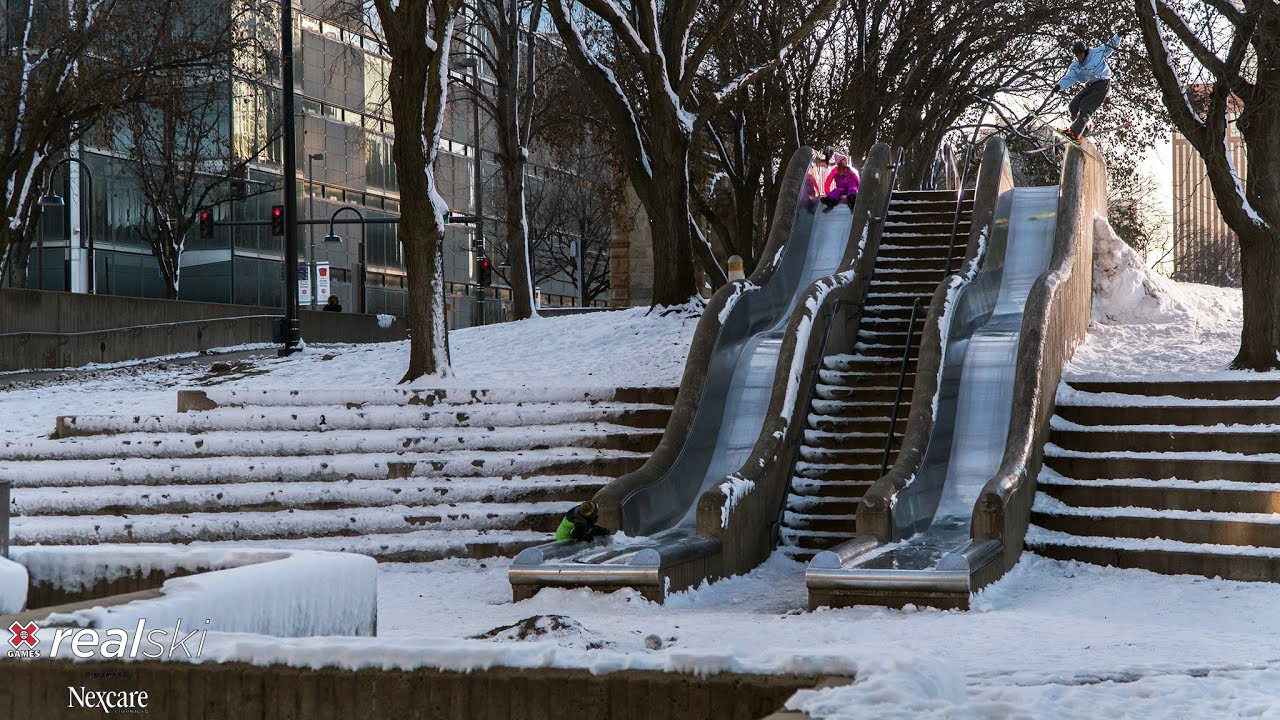
The roof was flat, white, and wrong for skiing, with the drop waiting beyond a hard edge and a thin urban landing below. Jake Mageau rolled in with the loose body language of someone who had already accepted the bad idea.
Real Ski 2020 gave that moment a name. Blister’s interview centered part of the conversation on the “Mind Flip,” the trick from Mageau’s winning X Games Real Ski edit with filmer Oliver Hoblitzelle. The shot fit the skier because it did not look like a normal street trick scaled up for judges. It looked like a private problem solved in public: roof speed, rotation, impact, camera angle, and a landing that left viewers trying to understand what had just happened.
Maui To Bend Before The Pipe Walls
Mageau’s route into skiing is unusual even by freeski standards. In a Newschoolers interview, he said he was born and raised in Maui, then moved to Bend, Oregon, when he was seven and started skiing there. The detail is not decorative. It explains part of the contrast in his career: island childhood, Mount Bachelor winters, halfpipe discipline, street creativity, fishing seasons, and a nickname that kept the Maui thread alive.
His FIS profile places him under Mount Bachelor Sports Education Foundation with FIS Code 2530787 and birth year 1997. That Bend base matters because Mount Bachelor gave him snow, transition, park access, and a scene where Gabe Ferguson, Hunter Hess, and other Oregon riders built different versions of freestyle. Mageau did not grow out of a standard Olympic pipeline. He came from a place where weather, friends, transition skiing, and camera curiosity all mixed early.
Chiesa In Valmalenco And The Halfpipe Years
Before Real Ski, before Knuckle Huck, and before the Mango identity became the main public reference, Mageau had a formal halfpipe record. FIS lists him second in halfpipe at the 2015 FIS Junior World Ski Championships in Chiesa in Valmalenco, Italy. The result remains the strongest medal line in his federation profile.
The same record shows World Cup halfpipe starts at Cardrona, Mammoth, Park City, Copper, Aspen/Snowmass, and other venues from 2015 through 2018. He reached seventh in a 2018 Mammoth Mountain World Cup halfpipe, which gives the contest chapter more weight than a casual footnote. Halfpipe taught him transition pressure, speed in short space, wall timing, and impact control. Those skills later reappeared in strange places: street drops, roof flips, knuckle tricks, and small features treated like curved walls.
Why Halfpipe Could Not Hold Him
The Newschoolers interview is useful because Mageau explained the contradiction himself. He liked halfpipe, but he also liked skiing everything else. He described the pipe as transition-heavy and different from hitting jumps, yet also said that leaving full-time halfpipe competition gave him freedom to film and explore other ideas.
That shift shaped the rest of the career. Many halfpipe skiers either stay with contest walls or disappear from the main freeski conversation. Mageau moved sideways. His halfpipe body control became a tool for street skiing, while his curiosity pulled him toward features other riders might ignore: curbs, roofs, rails, small transitions, damaged snow, and urban objects that needed imagination before technique.
Real Ski 2019 And The Fan Vote
Real Ski 2019 was the first major public proof of the new direction. X Games listed Mageau as a Bend, Oregon skier and a Real Ski rookie. His entry, filmed with Oliver Hoblitzelle and Christian Raguse, won the Fan Favorite vote and pushed him into the street-skiing conversation beside names already accepted in that format.
The result mattered because Fan Favorite is not the same as a judged medal, but in video skiing it can be just as revealing. Viewers reacted to the way Mageau moved: slow confidence, unexpected setups, roof lines, rails, transitions, and a willingness to make a trick feel slightly absurd before it became clean. Real Ski is built from ninety-second urban edits. Mageau’s part made the format feel like a personal introduction rather than a contest application.
Real Ski 2020 With Oliver Hoblitzelle
One year later, the judges followed the public. Newschoolers’ Real Ski 2020 results listed Mageau as the gold medalist, ahead of Emile Bergeron and Alex Hackel. Blister described the event as an invitation-only contest where top skiers build a ninety-second street edit, then interviewed Mageau about location scouting, the roof, the dam, headspace before filming, and the Mind Flip.
That context is important because Real Ski is not a one-day course. It is weeks of searching, shoveling, testing speed, returning to spots, waiting for snow, asking whether a landing will work, and filming until the shot carries enough weight. Mageau’s win placed him in a street lineage with skiers such as Phil Casabon, Magnus Granér, Tom Wallisch, Alex Hackel, LJ Strenio, and Mike Hornbeck. His version was not the cleanest technical style. It was stranger, softer, more elastic, and harder to predict.
How Mango Turns Small Obstacles Into Main Features
Mageau’s skiing is built around conversion. A curb can become a transition. A roof can become a takeoff. A knuckle can become a halfpipe wall. His vocabulary includes front flips, hand drags, nose pressure, tail pressure, rail taps, butters, switch landings, roof drops, corked rotations, halfpipe airs, knuckle huck transfers, and landings that often look like he is still deciding where the trick ends.
Compared with Tom Wallisch, Mageau is less locked and less symmetrical. Compared with Phil Casabon, he is less purely technical in rail vocabulary and more drawn to strange spatial ideas. Compared with Jesper Tjäder, he is not engineering the rail itself; he is finding weirdness in the object already there. Compared with Alex Hackel, he shares an interest in humor and surprise, but his movement carries more halfpipe transition memory.
Knuckle Huck At Aspen In 2022
X Games Aspen 2022 gave Mageau a second medal lane. In Wendy’s Ski Knuckle Huck, Quinn Wolferman won gold, Mageau took silver, and Alex Hall earned bronze. The result made sense because Knuckle Huck rewards exactly the kind of feature reading that had made Mageau’s Real Ski parts stand out.
The knuckle is not a normal jump. It is the rollover, the edge, the awkward part most riders use only to pass over. Mageau’s halfpipe background, roof confidence, and street balance all translated there. The format rewards nose butters, hand drags, low rotations, strange grabs, body shape, and tricks that use the curve rather than fight it. Mageau did not need the largest air in Aspen. He needed to make the wrong part of the jump look like the whole point.
ON3P Streets And The Mango Ski
Blister identified Mageau as an ON3P athlete during the Real Ski 2020 interview, and Downdays later described ON3P 6 as a full urban movie with long-time team members and street skiers including Jake Mageau, Forster Meeks, Eirik Moberg, Oscar Weary, Chase Mohrman, and Maximilliam Smith. That crew context fits him better than a normal sponsor paragraph.
ON3P’s street identity gives Mageau a ski culture built around durability, rails, weird urban approaches, and athlete-made visual language. The Mango pro-model thread extends that identity into equipment. A Mageau ski has to be playful enough for butters and small transitions, strong enough for street impact, and stable enough for landings that were not shaped by a park crew. The tool needs to survive the way he sees terrain.
686, Water, And The Off-Season Mirror
686’s profile of Jake “Mango” Mageau frames him as born in Hawaii, raised in the mountains, and recharged on the water. The same piece describes him as a snow artist, visual artist, pro skier, dog dad, and licensed fishing guide. That is not normal athlete copy, but it gives useful context for why his skiing looks so self-directed.
The fishing detail matters because it mirrors his riding. Both involve patience, place, timing, and a tolerance for long waits before one short moment. In winter, he searches for a roof, rail, dam, or knuckle that can carry a trick. In summer, he searches water. The public profile should not reduce that to lifestyle branding. It explains why Mageau’s skiing often feels like observation first and action second.
Wind For Whistles With Brady Perron
Wind for Whistles, made with Brady Perron and presented with Level 1, extended Mageau’s film identity beyond Real Ski. Prime Skiing described the 2025 piece as the third collaboration between Mageau and Perron, built around powder and street shots, early Mango context, and support clips from friends. Newschoolers’ video listing framed it as a place where athleticism meets artistry, moving from the eastern seaboard to northwestern locations.
The film matters because it avoids boxing Mageau into one discipline. Real Ski gave him urban credibility. Knuckle Huck gave him X Games format visibility. Wind for Whistles brings in powder, friends, memory, and a less compressed rhythm than a ninety-second contest edit. The collaboration with Perron also gives his skiing a different visual tone: less score-driven, more reflective, but still built around unusual movement.
The Footage Path From Pipe To Street
FIS lists Mageau as not active, so his current page should not present him as a World Cup halfpipe skier. The stronger version is clearer: former halfpipe competitor, Junior Worlds medalist, Real Ski gold medalist, Knuckle Huck silver medalist, ON3P street skier, 686 athlete, and one of the most distinctive American creative skiers of his generation.
For skipowd.tv, the watch path starts with Chiesa in Valmalenco 2015 for the halfpipe base, then moves to Mammoth 2018 for the World Cup peak. Real Ski 2019 gives the Fan Favorite breakthrough, Real Ski 2020 gives the gold and the Mind Flip, Aspen 2022 shows the Knuckle Huck silver, ON3P 6 places him inside a street crew, and Wind for Whistles shows the wider Mango world. Jake Mageau’s value is not a long medal list. It is the way he makes skiing feel possible on objects that did not ask to be skied.