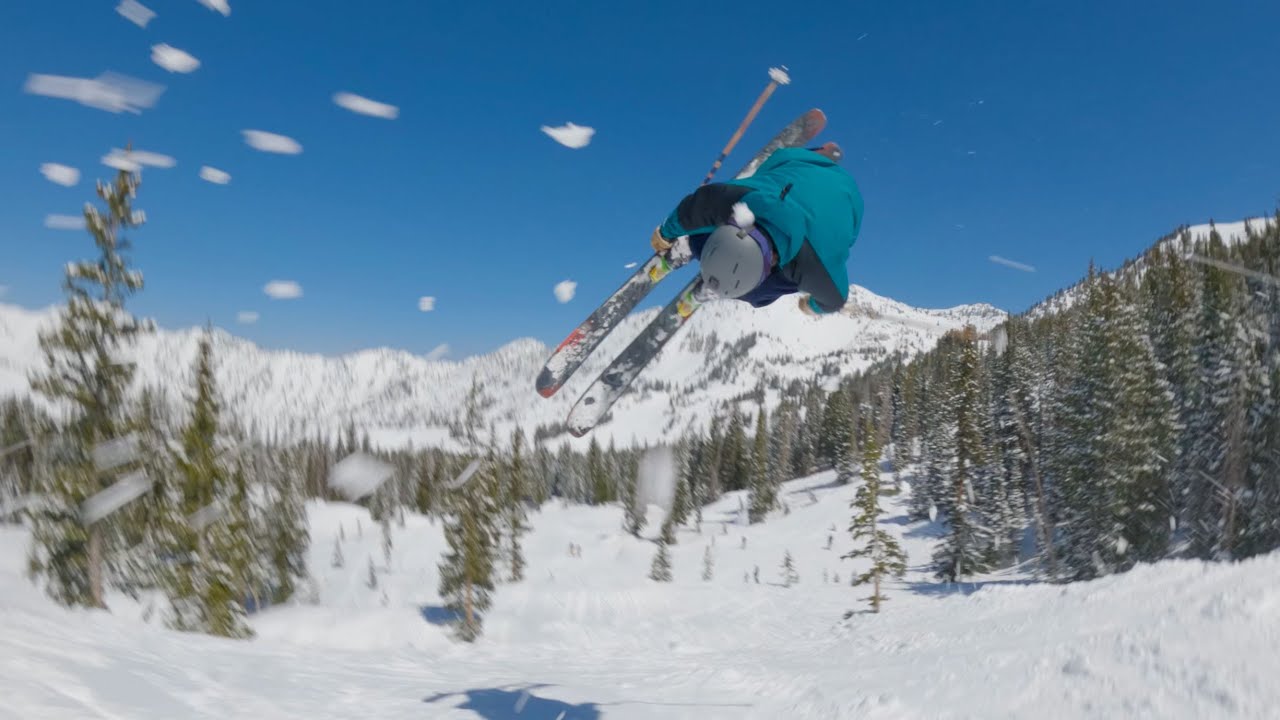
Ross Tester
Truckee / Salt Lake City, USA | Active: 2021-present FWT record | Discipline: Freeride, Big Mountain and Backcountry Freestyle | Known for: FWT Rookie of the Year, Baqueira win, Verbier podiums, Here 4 Now
Haines When The Cornice Opened
The Haines face stood over Alaska with spines stacked like frozen ribs and Pacific snow packed into the gullies. Ross Tester dropped from a huge cornice in March 2026, landed clean, then kept the line moving through 360s, fast turns and exposed terrain. The venue had not hosted the Freeride World Tour since 2017, and the return carried the weight of Alaska’s old freeride language: commitment first, style only if the mountain allowed it. Tester finished third that day, but the run did more than protect points. It showed why his skiing still reads differently on a broadcast: loose enough to feel improvised, controlled enough to survive big consequences.
Truckee, Squallywood And The Palisades Imagination
Tester grew up in the Truckee-Tahoe area, with Palisades Tahoe as the mountain that shaped his skiing. In a Palisades Tahoe interview, he said the resort became his home mountain because it was where his parents skied, then turned into a place he loved through the ski team and the culture around him. He read Robb Gaffney’s Squallywood, watched Greg Stump’s Blizzard of Aahhh’s and saw the Freeride World Tour in person as a young skier.
That background matters because Palisades is not a gentle freeride school. The mountain’s reputation comes from cliffs, fingers, hidden airs, steep entries, fast traverses and a local culture that rewards skiers who can turn small terrain into a full performance. Tester’s later FWT identity makes sense through that lens. He skis big faces with the reflexes of someone who grew up seeing natural features as invitations rather than obstacles.
Junior Worlds Before The Big Tour
Tahoe Quarterly documented Tester’s junior path in detail, including more than 50 contests, many podiums and a Junior Freeride World Championships title in Andorra when he was 17. The same piece described him moving through the Tahoe Junior Freeride Series, then into Freeride World Qualifier events after turning 18. That path built the competitive base long before he became a FWT broadcast name.
The junior world title also reveals an early tension in his skiing. According to the Tahoe Quarterly story, his coach advised him to back off the biggest tricks in low light and difficult snow at Andorra. Tester wanted to charge harder, but he accepted the line, skied smart and won. That lesson stayed relevant later. His best FWT runs are not reckless. They are calculated enough to look almost reckless.
University Of Utah And The Qualifier Grind
Tester’s move to Salt Lake City gave him another base. At the University of Utah, he studied strategic communications while trying to qualify for the Freeride World Tour. He later wrote for the university that the first three years involved injuries, work, school, finances and Freeride World Qualifier travel across the United States and Canada.
That period also produced the University of Utah Freeride Team. Tester said he started the club to help other students handle travel, accommodations and the costs around freeride events. The club then won the overall collegiate standings, while he qualified first in the North American region for the Tour. That part of his biography matters because it shows a skier building infrastructure around the dream, not only chasing it alone.
Fieberbrunn And The Rookie Shock
The 2021 Freeride World Tour season made Tester impossible to ignore. FWT later summarized his debut year as one that included two victories from three qualifying competitions and the Rookie of the Year title. The University of Utah piece adds that he finished fourth at Xtreme Verbier and took second overall in men’s ski during his rookie season.
Downdays’ archive points to Fieberbrunn 2021 as one of the defining moments, with Tester winning on the Wildseeloder face in Austria. That venue demands more than a big air. It asks riders to manage blind rollovers, cliff bands, snow texture and speed through a run that can fall apart quickly after one late turn. Tester’s rookie year placed him in the top tier before the rest of the field had fully adjusted to his pace.
Third Overall In 2022 And The Freestyle-Freeride Blend
The follow-up season kept him there. FWT’s own rider spotlight states that Tester finished third overall in FWT22. That ranking is important because it removed the easy explanation that 2021 was only rookie momentum. The field had seen him, judged him, planned against him, and he still returned to the overall podium.
His skiing works because the trick package is built into the line rather than placed on top of it. Backflips, 360s, cliff drops, double backflips, cornice entries, slashes and fast exits appear in his public record, but the order is the point. Tester often starts with terrain choice, then lets tricks appear where the face gives him enough speed and landing space. That is why his runs can feel playful without losing the big-mountain frame.
Here 4 Now From Salt Lake To Tahoe
After several intense FWT seasons, Tester stepped away from the Tour and made Here 4 Now. The film guide for iF3 describes the project as Ross exploring nature’s imperfections after stepping back from FWT, while Freeskier called it his first solo project. Freeskier also listed Palisades Tahoe, Snowbird and Alta as central terrain in the piece.
Here 4 Now matters because it reframed him. The film was not a standard sponsor recap or a medal edit. It followed Tester’s attempt to reconnect with skiing without the constant pressure of rankings. Freeskier’s credits listed Ross Tester as director, Ross Tester, Hadley Michaels and Ethan Herman as producers, and Jacob Callaghan on edit and score. That gave him authorship, not just athlete placement.
Baqueira 2025 And The Wildcard Return
The return to FWT in 2025 turned the film pause into a competitive reset. FWT lists Tester as a Season Wildcard that year, winning the Baqueira Beret Pro, finishing second at Xtreme Verbier and ending sixth overall. Dalbello’s recap of Baqueira reported a 92.67-point winning run on La Bamba, built from a backflip, a 360 grab and controlled skiing through steep terrain.
Baqueira was the right venue for the comeback. The Pyrenees face has technical rock drops, steep pitches and enough room for riders to expose their intentions. Tester did not return by skiing cautiously. He returned with the same blend that made his first FWT seasons dangerous: freestyle moves embedded into a real freeride line, not a trick list separated from the mountain.
Comeback Across Europe And Canada
Comeback, released through Pangea Collective, followed the next layer of that return. Newschoolers listed Ethan Herman as director and named Völkl, Dalbello, Marker, Flylow and BCA as support. The filming locations also tell the story: Baqueira Beret, Val Thorens, Kicking Horse, Georgia and Verbier.
That location list is more than travel. Baqueira gives Pyrenean rock and variable snow. Val Thorens adds high French Alps exposure. Kicking Horse brings British Columbia steepness and snow texture. Georgia gives Tetnuldi terrain and unfamiliar competition rhythm. Verbier closes the story on the Bec des Rosses, where every freerider’s score feels amplified. The film’s title worked because Tester was not returning to easy ground.
Val Thorens, Haines And The 2026 Podium Season
By 2026, Tester had turned the comeback into another overall podium. His FWT rider page lists him third overall in men’s ski with 23,980 points. The season line is specific: fifth at Baqueira Beret, third at Val Thorens, third at the YETI Alaska Haines Pro and tenth at Xtreme Verbier.
Haines was the strongest visual proof. FWT described the venue as steep spines, deep powder, complex terrain and dramatic relief, with a 740-meter descent and 45-degree average steepness. Tester finished third there behind Toby Rafford and Ugo Troubat. That podium mattered because Alaska strips away parts of the standard European playbook. The lines are bigger, the spines are sharper, and style has to survive terrain that punishes hesitation.
How Tester Makes Freeride Look Loose
Tester’s style sits between competition discipline and resort-bred improvisation. He can ski like a Palisades local, reading side hits and cliff bands with quick intuition, but he also understands judging: line score, control, fluidity, air and technique. The tension between those two systems is what makes his best runs watchable.
Technically, his skiing uses fast fall-line turns, 360 grabs, backflips, double backflips, large cliff drops, cornice entries, natural transitions, slashes and late speed checks. The body language is relaxed, but the decisions are not casual. He often looks like he is skiing with extra room, even when the face is tight. That calm is the signature. It lets him make dangerous terrain feel playful without pretending the danger has disappeared.
Völkl, Flylow And The Tahoe Support Line
Tester’s sponsor picture is well documented across recent projects. Powder quoted him thanking Tahoe Sports Hub, Flylow, BCA, Marker, Dalbello and Völkl in 2024. Newschoolers’ Comeback page later listed Völkl, Dalbello, Marker, Flylow and BCA as project support. Flylow also hosts an athlete profile for him, describing him as born and raised in Truckee, California and developed through the Palisades Tahoe team.
The sponsor mix fits the terrain. Völkl, Dalbello and Marker form the hardgoods system for aggressive freeride skiing. BCA connects directly to avalanche safety and backcountry travel. Flylow ties him to an outerwear brand with deep freeride roots. Tahoe Sports Hub keeps the hometown thread alive. Tester’s career has always balanced global FWT venues with local identity, and the support line reflects that split.
The Boss Ross Chapter Still Open
Ross Tester lands at 4/5 because the record is already major: Junior Freeride World Champion, FWT Rookie of the Year, second overall in 2021, third overall in 2022, Baqueira Beret winner in 2025, Xtreme Verbier podium, third overall in 2026, and recent film projects with Here 4 Now and Comeback.
He is not a FWT overall champion yet, and he is not an Olympic or X Games medalist, so the page should not push him into a finished-legend category. His current value is sharper than that: a Tahoe-raised freerider who left the Tour, made a personal film, returned as a wildcard, then put himself back on the overall podium through Baqueira, Val Thorens, Haines and Verbier.