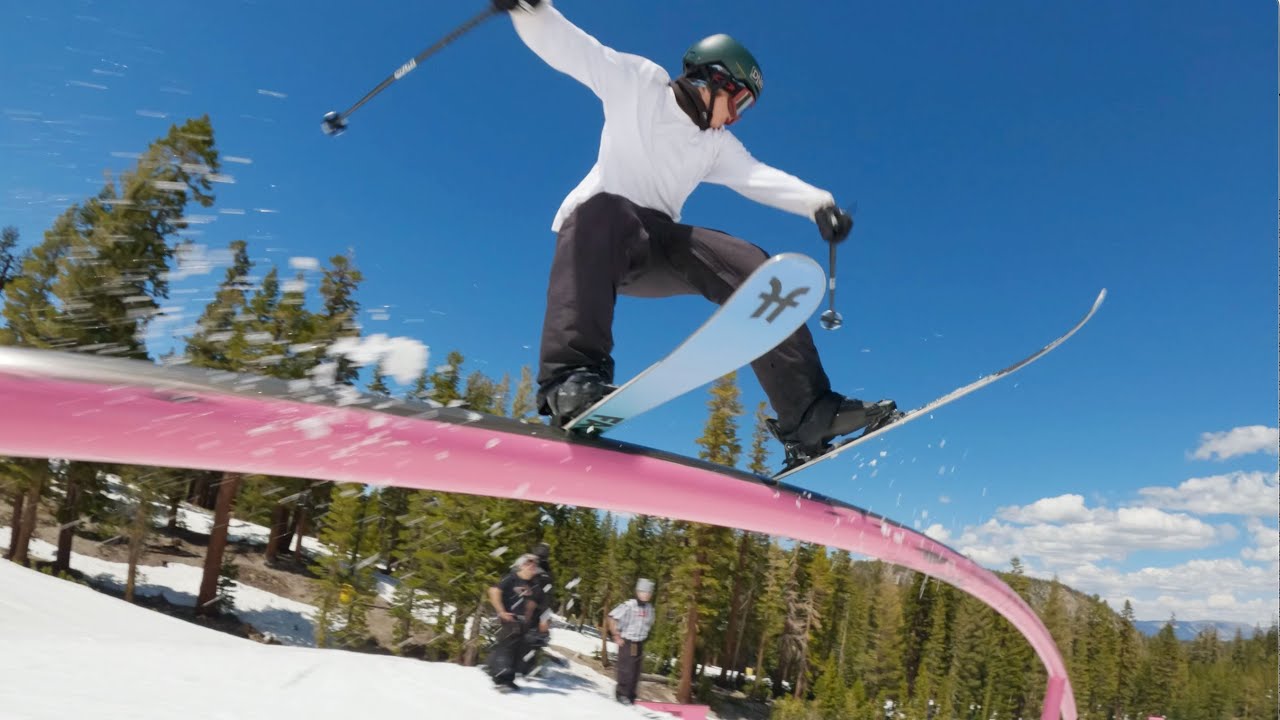
Luke Harrold
Lake Hāwea, New Zealand | Active: FIS status active | Discipline: freeski halfpipe, with big air and slopestyle background | Verified: 2024 Youth Olympic halfpipe gold, 2024 Youth Olympic big air bronze, 2025 Worlds halfpipe 4th, 2026 Snow League champion, 2026 Silvaplana World Cup winner | Current: New Zealand freeski halfpipe team, Atomic athlete support
Silvaplana When The Last Hit Carried Everything
The Corvatsch pipe was cold and sharp in late March, with the Swiss light flattening the blue walls and the last hit waiting above a hard landing. Luke Harrold came in switch, opened the run with alley-oop doubles, then saved the heaviest move for the bottom.
On March 29, 2026, Harrold won his first FIS Freeski Halfpipe World Cup in Silvaplana with 93.25. The run moved past Estonia’s Henry Sildaru, who had been sitting on 88.00 after his own Olympic silver-medal season. Harrold’s line included switch right alley-oop double 900 critical grab, switch left alley-oop double 900 mute, switch left cork 720 Japan, right double 1260 mute, and a left double 1620 safety to close. It was not a junior promise anymore. It was a senior World Cup win at the end of a season that had already tested him at the Olympics and Snow League.
Lake Hāwea To Cardrona’s High Performance Centre
Harrold was born in Christchurch in 2008 and calls Lake Hāwea home. His skiing started through the local Hāwea Flat Primary School programme at Cardrona Alpine Resort, a detail that gives the story a very New Zealand texture: school ski days, Southern Alps weather, bus rides, and a resort that has become one of the world’s most productive freestyle training bases.
He later trained with the High Performance Centre at Cardrona and entered his first competitions in 2016 at the Junior Freestyle Nationals. Snow Sports New Zealand talent-identified him in 2018 and brought him into the National Development Team. That pathway gave him structure before he was a teenager, but the environment mattered just as much. Cardrona offers halfpipe walls, park jumps, rails, airbags, and southern-winter timing when northern-hemisphere athletes are often chasing off-season camps.
Secret Garden At Fifteen
The first senior shock came at Secret Garden, China, in December 2023. Harrold made his FIS World Cup debut in freeski halfpipe and finished second, becoming the youngest New Zealand freeskier to stand on a World Cup podium. The venue already carried Olympic weight because it had hosted the Beijing 2022 pipe events.
For a fifteen-year-old, the result was unusually direct. He did not ease into the circuit through minor finals and quiet qualifiers. He arrived in a top-level halfpipe field and immediately scored beside established senior riders. The line also connected New Zealand’s halfpipe generation: Nico Porteous had already won Olympic gold in the discipline, Finley Melville Ives was rising through the same domestic system, and Harrold’s podium gave the next wave a hard number instead of just training-camp talk.
Gangwon Gold With Big Air Bronze In The Same Week
The Gangwon 2024 Winter Youth Olympic Games gave Harrold his first global medal week. At Welli Hilli Park, he won freeski halfpipe gold with 94.25 and added bronze in big air with 172.25. He also finished sixth in slopestyle, which showed a broader freestyle base before halfpipe became the cleanest route.
The halfpipe final carried extra New Zealand meaning because Finley Melville Ives took silver behind him. Two Kiwi freeskiers on the same Olympic-format winter podium created a rare team image: two young riders from the same national system, both already pushing senior-level pipe vocabulary. Harrold’s big air bronze added another layer. It showed he could manage a one-jump format, land under medal pressure, and bring rotation control outside the pipe walls.
Engadin And The First Triple Cork In Pipe Competition
The 2025 FIS Freeski Halfpipe World Championships at Engadin became Harrold’s most important technical marker. He finished fourth overall, but the result line does not carry the whole story. During that competition, he became the first skier to land a triple corked rotation in a freeski halfpipe contest.
That matters because halfpipe skiing has different physics from big air. A triple cork in pipe is not launched from a single long, shaped kicker. It has to come from wall speed, transition pressure, edge set, pop, amplitude, and enough spatial awareness to return to a steep landing while keeping the run alive. The move placed Harrold in a new technical conversation before he had an Olympic final or senior World Championship medal. It also made his fourth place more meaningful than a near-podium footnote.
How Harrold Uses Both Walls
Harrold’s skiing is already built around switch direction, alley-oop takeoffs, double rotations, grab clarity, and late-run escalation. His Silvaplana-winning run shows the structure: switch right alley-oop double 900, switch left alley-oop double 900, cork 720, double 1260, then double 1620. The difficulty increases without turning the first hits into warm-up airs.
Compared with Alex Ferreira, Harrold is still less polished in amplitude management and run presentation. Compared with Brendan Mackay, he has less senior-season volume but a sharper youth-to-progression curve. Compared with Finley Melville Ives, his closest New Zealand reference, Harrold looks more defined by high-risk progression moments: the triple cork at Engadin, the Snow League head-to-head pressure, and the Silvaplana last-hit 1620.
The technical question is consistency. Halfpipe rewards height, clean grabs, rotation variety, takeoff direction, and landing position, but it also punishes small speed errors. Harrold’s best runs already have world-level difficulty. The next step is repeating them through qualifiers, finals, Olympic weather, and changing pipe shapes.
Finley, Nico, And The New Zealand Pipe Room
Harrold’s development is inseparable from the New Zealand halfpipe group around him. The New Zealand Olympic Team reported that he has trained alongside Finley Melville Ives since childhood and described Finley as a constant competitive reference. That kind of rivalry matters in a small national programme because daily comparison can be sharper than any official ranking.
Nico Porteous also sits above the pathway as the obvious benchmark. Harrold has publicly referred to Porteous as the standard, which makes sense: Olympic halfpipe gold from Beijing 2022 gave every young Kiwi pipe skier a local proof that the route could end at the highest level. Ben Barclay and Zoi Sadowski-Synnott add senior team experience in different freestyle events, giving Harrold a team environment rather than a lone teenage campaign.
Atomic, National Support, And The Cost Of Progression
Atomic’s 2026 season recap placed Harrold inside its freeski athlete group, noting his first World Cup win and Snow League overall title. That support fits the current stage of his career. Halfpipe progression at this level needs more than talent: skis with stable swing weight, boots that can hold pressure through high walls, travel backing, coaching, physiotherapy, and enough snow time to repeat dangerous tricks safely.
The New Zealand system is also part of the support picture. Snow Sports New Zealand lists him through its freeski athlete profile, while the national Olympic pathway records his Youth Olympic results and Milano Cortina debut. The athlete is still young, but the structure around him is no longer developmental only. He is being measured against senior World Cup winners, Olympic medalists, and Snow League head-to-head riders.
Livigno Was The Hard Lesson
Milano Cortina 2026 gave Harrold his first Olympic Winter Games start. At Livigno Snow Park, he finished fifteenth in men’s freeski halfpipe qualification with 65.50 and did not reach the final. The official result is blunt, especially after the hype that followed Engadin and Snow League.
The timing of the event was difficult for New Zealand’s pipe team. Finley Melville Ives, the reigning world champion, crashed hard in qualification, while the men’s final later went to Alex Ferreira ahead of Henry Sildaru and Brendan Mackay. Harrold’s result should be read as a first Olympic contact, not as a ceiling. He had already shown senior podium ability before Livigno, then proved it again weeks later by winning Snow League at Laax and the World Cup at Silvaplana.
Laax, Season Two, And The Active Path
The Snow League changed Harrold’s 2026 profile. He finished second at the China freeski stop after a tiebreaker with Brendan Mackay, then won the LAAX finale and the inaugural men’s freeski Snow League championship. The format suited him because it compressed halfpipe into head-to-head pressure, repeated matchups, and a crowd-friendly structure.
His FIS status remains active, and the immediate factual path is clear. He exits the 2025-26 season with a World Cup win, a Snow League championship, a Youth Olympic gold-medal base, an Olympic debut, and a technical first at World Championships level. The next reliable viewing sequence for skipowd.tv is Cardrona for the origin, Secret Garden 2023 for the World Cup arrival, Gangwon 2024 for medals, Engadin 2025 for the triple cork, Livigno 2026 for the Olympic lesson, Laax 2026 for Snow League, and Silvaplana 2026 for the first World Cup win.