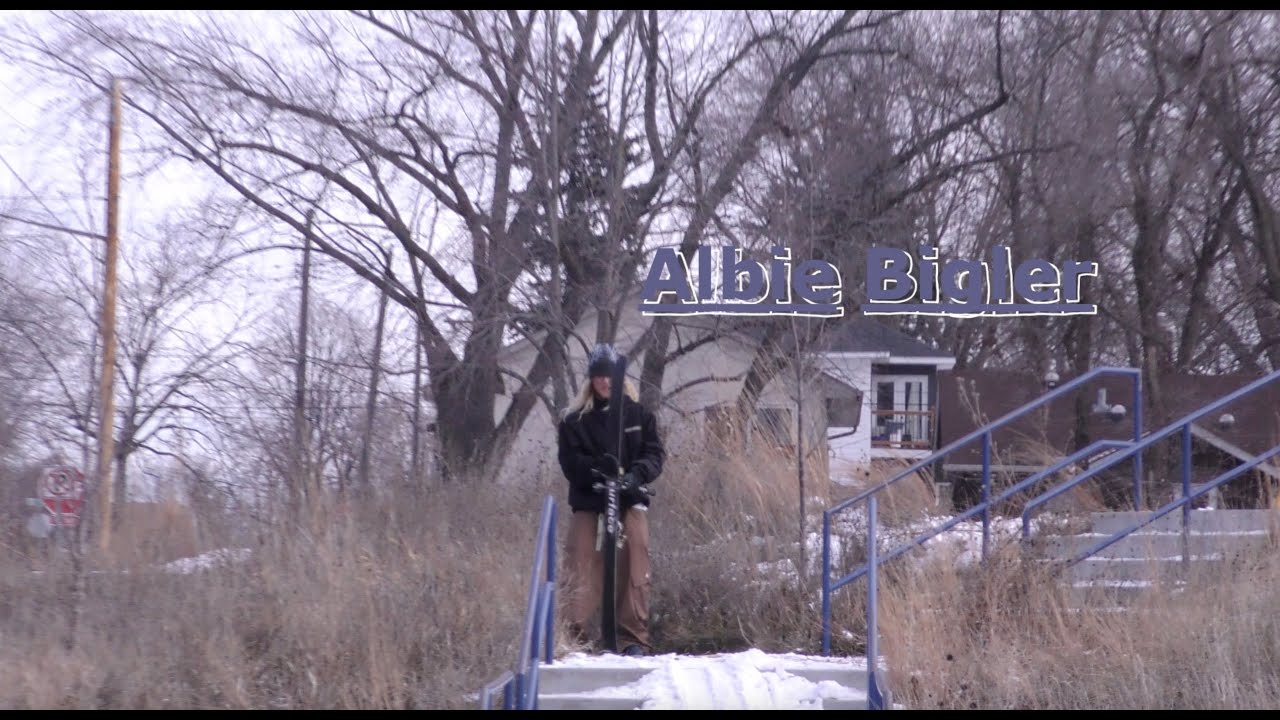
Albie Bigler
Leysin, Switzerland | Active: 2017-present public record | Known for: Gazolina.exe, Surface Skis, Leysin park style, street skiing | Current: Surface Skis team / Swiss street and park scene
Leysin Rails In Spring Light
The lower rail garden at Leysin catches late-season light before the snow turns slow. Albie Bigler’s skiing belongs to that setting: soft butter entries, low-speed redirects, rail pressure held past the obvious exit, and crew laps that feel more like a conversation than a judged run. His public profile is not built around World Cup scoreboards. It comes from a Swiss park and street lane where short edits, brand-team videos, local crews, and unusual feature use carry more meaning than an official ranking sheet. FIS lists him as a Swiss freestyle skier from Leysin, born in 2002, with FIS Code 2534400 and an inactive status, but the more current record lives in film and crew culture.
The Local Name Leysin Told People To Watch
By 2020, Bigler was already visible enough in Leysin that TWIN Magazine singled him out during a park check of the resort. The article described the local scene as active every weekend and named Bigler as a young skier with solid, original style, buttering everywhere and lapping with his crew in trains. That description matters because it fixes his skiing to a place and a daily rhythm. Leysin Park is not only a home resort label in his profile. It is the terrain where his style appears to have been built: repeated laps, changing rail setups, kicker lines from small to XL, a pipe zone, banked turns, transfers, and a park culture where creativity can develop away from formal contest pressure.
A Short FIS Trail Before The Video Path
The official record around Bigler is thin but useful. FIS identifies him under Switzerland, Leysin, and the 2002 birth year. Older Swiss Freeski Tour documents also place an Albie Bigler from Leysin in the Ski Romand structure during the 2016 Glacier 3000 slopestyle event record, though that entry is listed as DNS rather than a scored run. This is not enough to frame him as a contest skier. It does show that he came from the same development environment as many Swiss freeskiers, where club structures, park sessions and early event entries overlap before some riders choose podium chasing and others move toward filming, street trips and crew projects.
Surface Skis And The Wider Crew Map
Surface Skis lists Bigler on its team page alongside a mix of park, street and creative skiers including Harald Hellström, Mainio Ormio, Simon Geminiani, Jacques Summermatter, Finn Urey and others. That brand context fits his public archive. Surface’s team language is not built only around Olympic slopestyle or big-air podiums; it sits closer to style-driven skiing, small production crews, road trips and rail-heavy edits. For Bigler, the Surface connection also links him to “World Lap,” a 2023 Tyndall Wells short presented by Surface Skis, where he appears in a cast with Joe Blount, Jacques Summermatter, Harald Hellström, Mainio Ormio, Ruben Kallner Boman and Simon Geminiani.
World Lap Across Big Lines And Park Lines
“World Lap” is useful because it places Bigler inside an international Surface group rather than only a Leysin local frame. Newschoolers lists the film as directed by Tyndall Wells and filmed by a crew including Wells, Mike Ashworth, Sebastian Varlet, Ian Avery-Leaf, Sampo Valloton, Oliver Mathews-Lyon, Gavin Rudy, Stratton Mattsson and Caleb Ely. Downdays described the short as a mini movie combining big-mountain lines with Buldoz Invitational energy. Bigler’s presence in that cast suggests a skier comfortable inside blended projects: not purely street, not only park, and not presented as a traditional freeride athlete, but part of a modern crew format where style travels between terrain types.
Gazolina.exe And The Low-Fi Street Thread
The clearest current identity around Bigler comes through Gazolina.exe. Knuckle Magazine published a 2024 feature with a photo caption naming Basile Genevay and Albie Bigler of Gazolina.exe watching the spring park. Freeride.cz later framed “Egal” as a Swiss street crossover from Finland, connecting Buldozlife and Gazolina, with riders Benjamin Copt, Yohan Lovey, Albie Bigler and Basile Genevay. The location is important: Finland’s urban spots are a different test from a polished Alpine park. Short in-runs, cold metal, flat landings, stair sets, banks and night sessions ask for patience. In that environment, a skier’s choices often reveal more than a competition run can.
Gazo2042 From Norway To Switzerland To The USA
Gazolina’s third street video, “Gazo2042,” widened that thread in 2025. Downdays described it as a low-fi, street-swerving offering filmed around Norway, Switzerland and the USA, with skiing by Leonard Siegenthaler, Thomas Gaudin, Basile Genevay, Albie Bigler and Jesper Folkesson. The filming credits included Gazolina.exe, Number1.suspect, Eliot Golay, Remco Kayser, Hayden Benninghofen, Sleep Grill and Basco Paterno Castello. That production map says a lot about Bigler’s lane. His skiing is now attached to a cross-border street circuit, where riders trade spots, film with mixed crews, and build identity through clips rather than a single annual movie part.
Thun, Rails And Public Event Pressure
Bigler’s name also appears in the confirmed men’s field for Rock A Rail Ski Thun, listed by Snowfest among Swiss riders such as Till Matti, Tim Aufdermauer, Benjamin Copt, Jonas Hofer, Christian Moser, Leo Rupp, Silvan Borra, Lars Ruchti and Yohan Lovay. Rock A Rail is not a standard slopestyle course. It is a public rail-jam format, where speed control, feature reading, switch-ups, disaster transfers, lock-in quality and crowd pressure matter more than a rehearsed jump run. For a skier coming from Leysin laps and Gazolina street trips, that environment makes sense. It turns the language of street skiing into a visible event without removing the improvisational part.
SuperUnknown 22 And The Outside Signal
Level 1’s SuperUnknown 22 added another marker. Public listings identify Bigler as a SuperUnknown 22 semi-finalist, placing his footage inside one of freeskiing’s longest-running video discovery formats. SuperUnknown has historically rewarded skiers who can communicate identity through a short edit: trick selection, spot choice, pacing, rail control, landings and filming all count. Bigler did not need an Olympic qualification line to enter that conversation. His public ski record already had the pieces SuperUnknown tends to notice: a clear home scene, Surface links, Gazolina street footage, rail-event presence, and enough originality in park laps for local media to remember his name years earlier.
How Bigler Reads Small Terrain
Technically, the available footage context points toward a skier who values terrain reading over maximum amplitude. The recurring language around him is buttering, lapping, trains, street swerving and rail-heavy crew edits. Those words usually point to nose and tail pressure, low-speed balance, switch entries, controlled slides, creative line choice, wall contact, quick setups and comfort on imperfect snow. Bigler’s public image sits with skiers who make small features feel flexible. A flat rail can become a press, a bank can become a redirect, a park lap can become a linked train, and a city spot can work even when the in-run is too short for clean speed.
The Swiss Street Lane He Occupies Now
Bigler’s profile is still developing, and the strongest verified material remains scattered across team pages, video credits, street edits and event rosters. That makes him different from Swiss contest names whose careers can be tracked through FIS finals and World Cup starts. His current value is cultural rather than statistical: Leysin local style, Surface team visibility, Gazolina’s street projects, SuperUnknown recognition and rail-jam presence. The next factual points to watch are simple: whether Gazolina follows “Egal” and “Gazo2042” with a longer project, whether Bigler appears in more Surface team releases, and whether rail events like Thun keep pulling his skiing out of the edit and into public sessions.