Mountain Creek
New Jersey
United States
New Jersey ski resort in Vernon Township | Known for: South Peak terrain parks, 1040 feet of vertical, daily night skiing and complete snowmaking coverage | Season: mainly December to March | Best for: East Coast rail progression, night park sessions and high-volume freestyle laps near New York City
1480 Feet Above Vernon And One Hour From New York
Mountain Creek reaches a summit elevation of 1480 feet above Vernon Township in northern New Jersey, with 1040 feet of maximum vertical across four mountain peaks. The resort currently lists 46 trails and eight lifts, including two high-speed quad chairs and its distinctive eight-passenger Cabriolet. Natural snowfall averages only about 65 inches annually, so the mountain's winter operation depends heavily on one of its most important pieces of infrastructure: snowmaking covers 100 percent of the trail network.
The location is as important as the elevation. Mountain Creek sits inside the New York metropolitan orbit rather than deep in a remote mountain range. This gives skiers from northern New Jersey and New York City access to meaningful vertical, chairlift-served freestyle terrain and evening skiing without organising a trip to Vermont. The resulting ski culture is built around repetition: riders can arrive for an afternoon, stay under the lights and accumulate park laps instead of treating every visit as a destination holiday.
South Peak Turns An Entire Mountain Into A Terrain Park
South Peak gives Mountain Creek its strongest freeski identity. The resort describes the sector as an All-Mountain Terrain Park, with freestyle terrain extending across an entire mountain peak rather than being confined to one short trail. Current park designations cover Canyon, Lark, Lift Line, Jumping Jack, Bakersfield, The Gully, Tail Spin, Cloud 9, Buddy's Way, Red Tail and The Arena. Feature difficulty progresses from small ride-on boxes through medium street-style rails to large jumps and advanced lines.
This layout creates far more variation than a single conventional slopestyle course. A rider can use Canyon or Lark for lower-consequence progression, move toward Lift Line and Tail Spin for more technical jibbing, then enter large-feature terrain such as Red Tail when speed control and aerial confidence are established. Several trails combine Small, Medium and Large designations, allowing the shape crew to build multiple choices into the same descent instead of forcing every skier onto identical features.
The South Peak concept also makes normal mountain movement part of the park experience. Rollers, trail transitions and piste geometry connect individual constructed features rather than separating the terrain park behind one fence. That all-mountain approach has been part of Mountain Creek's freestyle identity for years and helps explain why the New Jersey resort can have regional influence despite its relatively low summit elevation.
Jersey Snowmaking Keeps The Park Building Through Thaws
A 1480-foot summit in New Jersey requires a different winter strategy from a high-altitude Western resort. Mountain Creek lists 100 percent snowmaking coverage and more than 1000 snowmaking machines across the property. Seven mountaintop lakes feed the system, and under ideal conditions the resort states that it can produce about 3.5 million cubic feet of snow in 24 hours, enough to cover approximately 80 acres.
A major automation project strengthened that system beginning with winter 2024-2025. The first phase represented a five-million-dollar investment around Vernon Peak, including new pipes, pump infrastructure, automated controls and 40 energy-efficient fan guns. Although the initial automation targeted major Vernon trails rather than South Peak alone, expanding snowmaking efficiency across the resort frees equipment and production capacity for the rest of the mountain.
For park skiing, that infrastructure is fundamental. Rails can be fabricated before winter, but jumps, transitions and landings require large volumes of snow. Freeze-thaw cycles are normal in the Mid-Atlantic, and rain can remove features much faster than at colder resorts. Mountain Creek therefore depends on short snowmaking windows to rebuild depth, restore approaches and keep park terrain usable through a highly variable regional climate.
Legacy Rail Jam Connects Great Gorge To Modern Park Skiing
Mountain Creek celebrated sixty years of local mountain history in January 2026, connecting the current resort with the Great Gorge and Vernon Valley era that began in the 1960s. South Peak hosted the Legacy Rail Jam on January 24 as part of the anniversary weekend. Ski and snowboard divisions included open, grom and over-40 categories, with separate recognition for Best Trick, Best Style and Best Overall.
The event deliberately used features associated with different periods of Mountain Creek's history. That choice reflects how deeply terrain-park skiing has become embedded in the resort's modern identity. South Peak is not simply the location where current rails happen to be installed; Mountain Creek's own anniversary programme presented it as the place where multiple generations of New Jersey freestyle riders developed their style.
The resort's competition history extends beyond local jams. Mountain Creek hosted U.S. Snowboarding Grand Prix events in the mid-2000s, when its superpipe was one of the notable pipe facilities in the eastern United States. The 2005 event formed part of the selection process leading toward the 2006 U.S. Olympic snowboard team. Modern Mountain Creek has shifted toward rails, jumps and all-mountain park terrain, but that earlier pipe period demonstrates that large-scale freestyle competition has been part of the mountain before.
Eight Lifts And Night Operations Change The Lap Count
Mountain Creek's eight-lift network includes two high-speed quads, an eight-passenger Cabriolet, additional fixed-grip chairs and beginner carpets. South Peak's lift configuration is particularly useful for freestyle because riders can remain within the park sector instead of repeatedly crossing the full resort. The wider mountain ticket still gives access to all four peaks, allowing a park session to be combined with conventional groomed skiing at Vernon or other sectors.
Night skiing is another major part of the operating model. Mountain Creek advertises daily night skiing during the winter season, with typical operations running from morning until 9 p.m. The importance goes beyond convenience. A rider leaving school, university or work can still fit several hours of skiing into a weekday, while a full-day visitor can continue lapping after sunset rather than losing the mountain when natural light disappears.
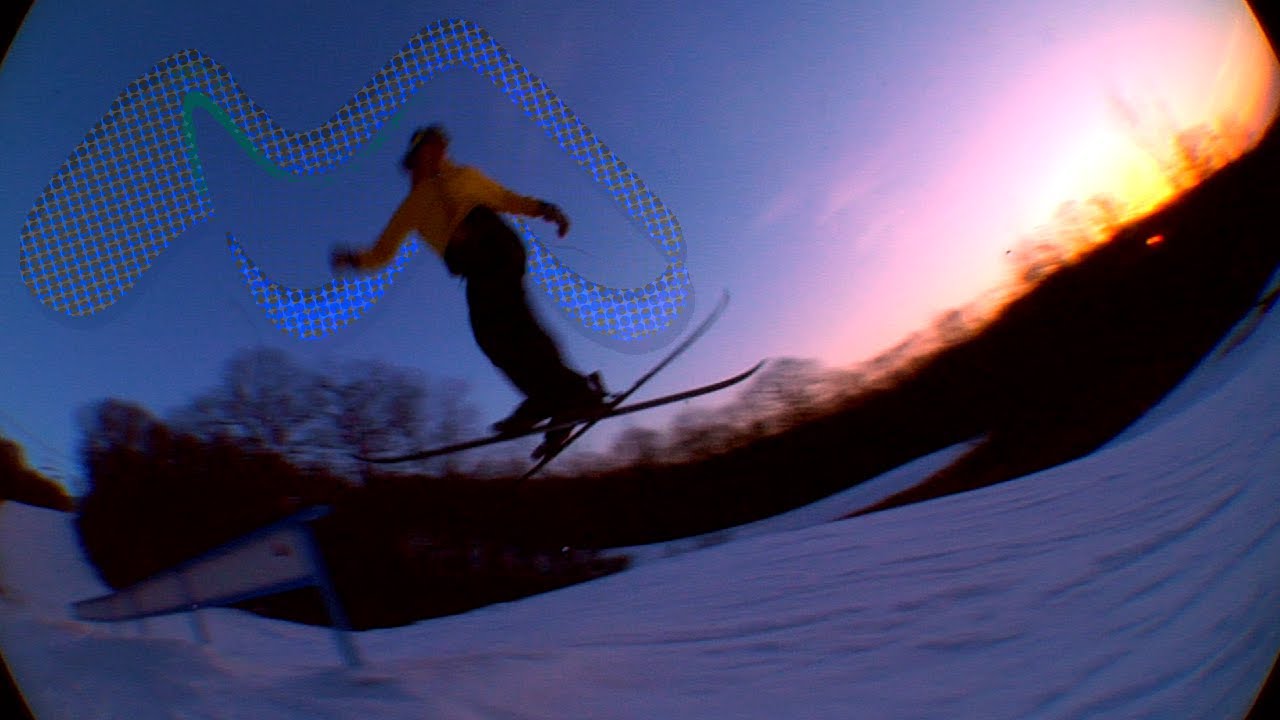
Artificial lighting changes park skiing technically. Contrast is different from daylight, shadows form around rails and landings, and snow can become progressively firmer as temperatures fall through the evening. Riders need to recheck speed rather than assuming an approach that worked during a soft afternoon will behave identically after dark. For regular locals, adapting to those changing surfaces becomes part of the Mountain Creek skill set.
South Peak Rewards Rails More Than Mountain Scale
Mountain Creek cannot compete with major Western resorts on snowfall, acreage or alpine relief. Its annual natural snowfall is around 65 inches and its summit sits below 1500 feet. Those limitations shape its freestyle culture rather than preventing one from existing. Technical rails, boxes and repeated park lines require far less vertical than long powder descents, making South Peak well suited to high-volume skill development.
The short vertical also changes progression. Riders can focus on one movement for multiple consecutive laps while memory of the previous attempt remains fresh. A skier learning a rail rotation may make more meaningful attempts in one evening at Mountain Creek than during a full day in a huge resort where every park lap requires a long lift and several kilometres of skiing.
The same logic explains why street-influenced features fit the mountain. Large steel rails and creative jibs turn limited natural relief into technical terrain. Mountain Creek's current park list ranges from ride-on progression features to large street-style rails and jumps, allowing the resort to use constructed difficulty rather than elevation as its main progression tool.
Vernon Peak Adds Groomers Beyond The Park Network
Although freestyle defines South Peak, Mountain Creek is not exclusively a park resort. Vernon Peak provides conventional beginner and intermediate terrain, including a Terrain Based Learning area for new skiers and snowboarders. The broader four-peak network allows riders to leave the park when features are crowded, being rebuilt or simply no longer the objective for the session.
This flexibility is particularly useful during variable East Coast weather. Firm morning conditions may favour groomed laps before park landings soften, while rain or a refreeze can make certain features temporarily less useful. A resort with 46 trails gives park skiers alternatives while they wait for shaping or surface conditions to improve rather than ending the day completely.
The terrain outside South Peak is not a substitute for large-mountain freeride. Mountain Creek's freeski relevance comes overwhelmingly from freestyle, snowmaking and accessibility rather than uncontrolled backcountry. Its all-mountain value is about mixing park laps with conventional East Coast skiing inside one compact resort.
Why Mountain Creek Still Matters To East Coast Freeskiing
Mountain Creek operates under physical constraints that would make a powder-focused resort unremarkable: 1480 feet at the summit, approximately 65 inches of natural snowfall and a winter typically concentrated between December and March. Freestyle changes that equation. South Peak turns multiple trails into park terrain, the snowmaking system covers the entire resort and night operations multiply the hours available for repetition.
The resort's 2026 Legacy Rail Jam demonstrated that this identity extends across generations, while the current terrain-park map still lists eleven specific park trails ranging from Small to Large. Add 1040 feet of vertical, 46 total trails and eight lifts, and Mountain Creek becomes more than a small New Jersey hill. Its importance comes from putting a dense, progression-oriented freestyle mountain inside the New York metropolitan region, where riders can build skills repeatedly without travelling north every time they want to ski a serious terrain park.