Victor Galuchot
Les Menuires, Savoie, France | Active: 2000s-present | Known for: Bon Appétit Ski, freeride films, steep skiing, environmental storytelling | Current: Elan-supported freerider, filmmaker and Freeski Belleville coach
Péclet After Lockdown
The glacier above Val Thorens was quiet in May, the lifts stopped, the valley emptied, and spring snow holding just long enough for skins, sleds, ropes, and a small crew to move upward. Victor Galuchot was not chasing Alaska or Japan. He was walking from home.
That scene from Projet Zéro marks the cleanest break in his career. Galuchot had already spent years turning freeride skiing into comedy, travel and chaos through Bon Appétit Ski. Then the same skier began asking what a professional mountain life costs. His best work now sits in that tension: fast skiing, steep terrain, friendship, humour, climate awareness, and a refusal to make freeride look disconnected from the world around it.
Les Menuires Before Bon Appétit
Galuchot comes from the Belleville valley, with Les Menuires and Val Thorens forming the mountains he knows most intimately. Skipass describes him as the son of a ski instructor who grew up with alpine foundations, an appetite for tricks, strong snow feel, and the ability to read terrain quickly.
Those early ingredients shaped the skier he later became. He was never only a freeride purist. His skiing carried park energy, old-school freestyle looseness, alpine control, and mountain knowledge learned through repetition. In the Belleville valley, that meant powder faces, couloirs, resort sidecountry, wind-loaded bowls, spring corn, and the kind of local judgment that only comes from years of watching the same slopes change through weather.
Bon Appétit Turned Freeride Into A Road Movie
Galuchot’s cultural breakthrough came through Bon Appétit Ski, the web series he created with Fabien Maierhofer. Outside describes the series as a reference in freeride culture, ending after nine seasons and nearly 60 films. Le Dauphiné had already marked its 50th episode in 2017, showing how large the project became before the final years.
Bon Appétit worked because it refused to make freeride look too polished. The skiing was serious, but the tone was road-trip chaos: jokes, bad weather, local encounters, improvised plans, food, costumes, crashes, friendships, and a willingness to show the mess around the line. Galuchot became one of the faces of a French ski culture that could ride hard without pretending every day in the mountains was heroic.
Iceland, Kazakhstan, And The Monster Episode Years
The series grew far beyond local resort content. Outside’s retrospective on Bon Appétit points to Iceland as one of Fabien Maierhofer’s strongest memories and Kazakhstan as the final “monster episode,” shown at High Five Festival and Les Séances Freeski before the series closed.
Those episodes gave Galuchot a specific place in European ski media. He was part athlete, part narrator, part comedian, part expedition partner. The snow mattered, but so did the journey. Viewers followed the crew because the films made skiing feel human: delayed, absurd, cold, hungry, risky, funny, and sometimes beautiful by accident rather than by script.
Projet Zéro And The Local Pivot
Projet Zéro, released in January 2021, became the turning point. L’Équipe described the film as Galuchot’s environmental awakening, shot after the first French lockdown on the Glacier de Péclet. Le Dauphiné framed it as a local, low-impact mission by a professional skier from the Belleville valley.
The project replaced the classic freeride fantasy of distant powder travel with a different challenge: start from home, use bikes, skins, sleds and legs, then ski close to the place that built you. The crew covered 27 kilometres and 1,300 metres of vertical gain toward the glacier before continuing on skins. The result kept Bon Appétit’s humour, but the message had changed. The mountain was no longer just a playground. It was a responsibility.
Conscience And The Wider Freeride Conversation
Galuchot’s environmental shift did not stay isolated inside one film. Ecolosport’s article on Conscience describes Gaëtan Gaudissart’s project as a journey through the Alps by bike and train, meeting freeride figures including Victor Galuchot, Liv Sansoz and Tony Lamiche.
That context matters because Galuchot became part of a wider conversation inside mountain sports. Professional freeride had long celebrated flight, remoteness, helicopters, deep winters and endless mobility. Galuchot did not deny that contradiction. He put it in front of the camera and let his own career become part of the problem he was trying to understand.
Les Étoiles De La Terre And The Mont-Blanc Turn
Les Étoiles de la Terre pushed the new direction higher and steeper. Alpine Mag described the film as Galuchot moving away from helicopters and distant travel to ski major Alpine lines with speed, fluidity and commitment. The Rider Post placed the film in the Mont-Blanc massif, across two winters, with Christophe Henry, Gaëtan Gaudissart and Kristo Baud appearing around the project.
The film’s subject was not only performance. Its title turns glaciers into “the stars of the Earth,” visible now but disappearing in front of the next generation. That image fits Galuchot’s current voice. He still wants strong skiing, but the line must now carry a second meaning: what does it mean to film beauty on terrain that is vanishing?
North-East Courtes And The Steep-Skiing Language
The Rider Post highlights a line on the north-east spur of Les Courtes in the Argentière basin, one of the film’s strongest Mont-Blanc moments. Le Dauphiné also described Les Étoiles de la Terre as including slopes up to 55 degrees.
That terrain changed the visual language around Galuchot. Bon Appétit often made him look playful, even when the skiing was exposed. In the Mont-Blanc films, the comedy pulls back. The skiing becomes more precise: crampons, ice axes, glacier approach, steep snow, sluff management, fall-line speed, jump turns only when needed, and the ability to stay fluid when the slope angle leaves little room for correction.
Parallelo And Twenty Years With Pierre Guyot
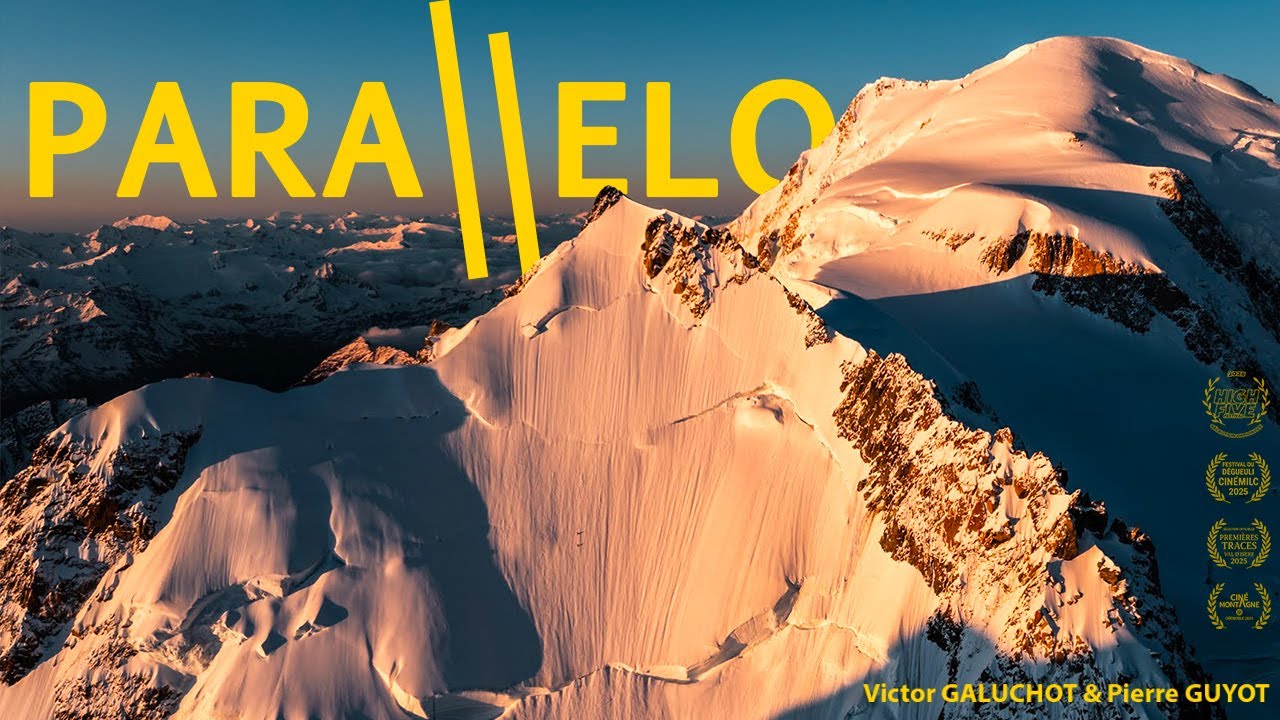
Parallelo, released in 2025, brought Galuchot’s story back to friendship. Alpine Mag describes the film as a portrait of twenty years skiing with Pierre Guyot, from early freestyle and freeride years toward steeper Mont-Blanc lines. Skipowd lists the film at Les Menuires with sponsors including Anon, Elan and Uvex.
The film matters because it avoids turning Galuchot into a solitary mountain prophet. His skiing has always been relational. Fabien Maierhofer shaped Bon Appétit. Gaëtan Gaudissart, Christophe Henry and Kristo Baud appear in the newer steep-skiing arc. Pierre Guyot gives Parallelo its emotional core. For Galuchot, skiing is rarely only a personal descent. It is a shared language built over years.
Elan, Les Menuires, And The Current Support Web
The most current public sponsor trail around Galuchot includes Elan Skis through Parallelo coverage, Les Menuires through his local identity and coaching role, and eyewear support noted on Skipowd’s profile. Earlier project pages also connect him with the Belleville valley’s ski culture rather than a single contest-tour brand image.
That support structure fits his current career. He is not selling a World Cup campaign. He is building films, skiing steep lines, coaching younger riders, representing Les Menuires, and trying to show a lower-impact version of professional ski storytelling. The brand value comes from credibility, not medal exposure.
How Galuchot Skis Now
Galuchot’s technical skiing has changed with his terrain. The visible toolkit now includes steep turns, high-speed freeride arcs, jump turns, sluff control, glacier travel, ski touring transitions, rope work, crampon approaches, and enough freestyle history to keep his skiing loose when the terrain allows it.
His strongest lines are not purely alpinist or purely freeride. They sit between both. He wants the flow of freeride, the discipline of steep skiing, and the narrative shape of a filmmaker. That combination gives his recent work its weight. The descent is never only a descent; it has to explain why the skier went there, who came with him, and what the mountain means after the camera stops.
The Current Shape Of Victor Galuchot
Galuchot’s public profile now has four clear chapters: the Belleville upbringing, the Bon Appétit years, the environmental pivot through Projet Zéro and Conscience, and the steep-skiing film period with Les Étoiles de la Terre and Parallelo.
His importance does not come from Olympic medals or a contest ranking. It comes from influence inside French freeride media. He helped make ski films funnier, more accessible and more human, then used the same visibility to question the travel-heavy dream that had supported his career. That arc makes him one of the most distinctive French freeride storytellers of his generation.