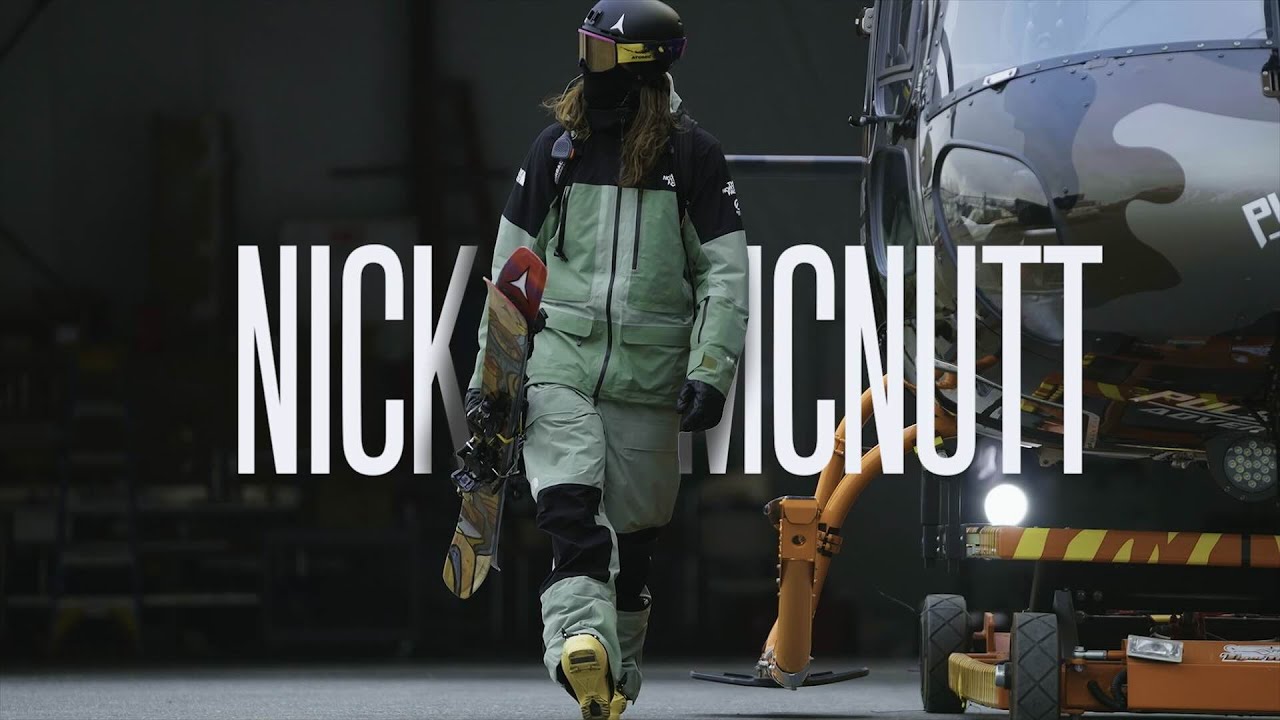
Nick McNutt
Kimberley / Squamish, British Columbia, Canada | Active: 2013-present | Focus: backcountry freestyle, powder films, switch landings, TGR segments | Current: The North Face and Atomic athlete
Whistler Pillow Snow Before The Switch Landing
The Whistler pillow line sat buried in coastal snow, each mound rounded by storm cycles and each exit hidden behind cedar branches. Nick McNutt rolled in with the calm of a skier who had already crashed the idea a hundred times before cameras arrived. He popped, turned backward, and landed switch in powder where most riders would fight just to stay forward. That movement became his signature because it was not decoration. It changed how backcountry freestyle could look: less about one cliff, more about linking pillows, nosebutters, tree taps, deep landings, and direction changes until the forest felt like a park built by weather.
Kimberley Skis With Heat-Gun Twin Tips
McNutt grew up in Kimberley, British Columbia, before Whistler shaped the rest of his skiing. The North Face describes his early setup with a detail that explains the self-made tone of his career: he skied park on Elan carving skis that he and his father modified into twin tips with a heat gun. That image matters because McNutt’s later style did not come from a polished academy pipeline. It came from improvisation. He was fascinated by switch skiing early, then kept falling until landing backward in deep snow became a skill rather than a trick. When he moved to Whistler at 17, the terrain finally matched the obsession.
Whistler At Seventeen And The Million Falls
Whistler gave McNutt the terrain that Kimberley could not provide at the same scale. The North Face says he bought his first powder skis and a snowmobile after moving there, then started spinning off pillows and backcountry booters while landing mostly switch. He worked construction jobs through summer and fall so he could ski more than 100 days each winter. That period shaped the body mechanics visible in his films: soft knees, quiet shoulders, strong air awareness, and a willingness to land into snow that might explode, grab, or collapse. The switch landings looked effortless later because the cost had already been paid far from the spotlight.
Co-Lab Did Not Need First Place
The path to Teton Gravity Research did not begin with an invitation. McNutt entered TGR’s open-source Co-Lab contest after a POV edit gained serious online traction. He finished runner-up, but the contest still changed his career. The North Face recounts that he secured a filming invite after a late-night game of pool with TGR’s founders. That detail fits the larger McNutt story. He did not arrive as a contest name or a resort-sponsored prodigy. He entered the ski-film world through footage, personality, timing, and enough originality that second place in an online competition mattered less than what the judges had seen on snow.
Almost Ablaze And The Rookie Shock
Almost Ablaze, released by TGR in 2014, became the defining public break. TGR later showcased his full segment and noted that the part earned him iF3 Rookie of the Year recognition and a Powder Awards nomination. The North Face adds the Powder Awards Breakthrough Performer result, and Powder Canada’s recap places the same segment at the start of his decade as one of TGR’s central skiers. The part worked because it felt new without needing a forced storyline. McNutt landed switch in powder, nosebuttered natural terrain, redirected over pillows, and moved through British Columbia snow with a park skier’s creativity and a backcountry skier’s reading of consequence.
Valhalla, Paradise Waits, And The TGR Thread
McNutt’s filmography widened quickly after the breakthrough. The North Face lists video parts with TGR since 2013 and a part in Sweetgrass Productions’ Valhalla. Ski film archives place him in Paradise Waits, while Powder Canada lists TGR’s The Co-Lab, Almost Ablaze, Tight Loose, and Paradise Waits among the key early credits. Those films matter because they show continuity. He was not a one-segment novelty built around switch landings. He became a repeat TGR athlete, trusted in deep snow, pillows, alpine faces, and film trips where weather windows, crew chemistry, and safety decisions can matter as much as the move itself.
Albania In Far Out
TGR’s Far Out gave McNutt one of his most memorable narrative roles. The North Face notes that he narrated the 2018 film and overcame obstacles in Albania’s Valbona Valley. That location changed the usual British Columbia powder frame. Albania brought unfamiliar mountains, complex access, uncertain information, and a sense of exploration rather than another familiar pillow zone. McNutt’s value in that kind of project is not only technical skiing. It is adaptability. A skier who learned in Whistler snow still has to read different avalanche problems, line shapes, snow texture, and group dynamics when the trip moves to terrain without the same local map.
The 2020 Burial Near Pemberton
McNutt’s career also includes one of the most discussed avalanche incidents in modern ski media. While filming for TGR near Pemberton, British Columbia, in March 2020, he was caught and fully buried in a slide. TGR reported that his transceiver stopped transmitting during the rescue, forcing partners into a difficult probe search. Maclean’s later described the crew and the mountain setting in detail, while Mountainwatch reported that he was buried for roughly five minutes and suffered injuries including a broken arm. The incident is important because it belongs inside the same environment that built his career: familiar backcountry, trusted partners, deep snow, and the reminder that local knowledge never removes consequence.
Magic Hour And The Mature TGR Skier
By Magic Hour in 2022, McNutt was no longer the surprising rookie. TGR described the film as a collection of powerful moments in wild places, and his athlete edit from that period continued the same language: pillows, powder, cliffs, backward landings, and natural transitions skied with a style that had become fully identifiable. The mature McNutt segment does not need to announce progression through rotation count alone. It works through flow. He enters a face, changes direction where the terrain allows, uses a pillow as takeoff, absorbs the landing, and leaves the frame with enough speed that the line feels connected rather than assembled from separate tricks.
Pressure Drop And Thirty Years Of TGR
Pressure Drop, TGR’s 2025 film, places McNutt inside the company’s 30-year anniversary chapter. iF3 describes the film as following skiers and snowboarders through massive cliffs, stacked pillows, and deep powder from Norway to British Columbia, California, Alaska, and Jackson Hole. TGR also published a 2025 deep-dive conversation with Todd Jones and McNutt around the film and the company’s three-decade history. That context matters for his legacy. McNutt entered TGR through an online contest, then stayed long enough to become part of the studio’s institutional memory. He is now both athlete and witness to a film lineage that shaped big-mountain skiing.
Atomic, The North Face, And The Backcountry Kit
The current support picture is clear. Atomic lists McNutt as a Canadian backcountry athlete with Whistler Blackcomb as home resort, while The North Face lists him from Squamish, British Columbia. Atomic product pages have tied him to freeride touring equipment such as the Backland 107, and the brand also released signature goggle work connected to his name. The gear story matches the skiing: wide skis for coastal powder, boots and bindings that can handle sled-access laps and touring missions, outerwear built for Alaska, Patagonia, Albania, Whistler, and Pemberton, plus enough durability for landings that are rarely clean in a park sense.
Switch, Nosebutter, Pillow, Exit
McNutt’s skiing can be summarized by a few repeated mechanics, but the result never feels mechanical. He lands switch in deep snow, nosebutters natural rolls, taps trees, spins off pillows, drops cliffs backward, and uses terrain as if it were a park line hidden under storm snow. CMH called him a master of landing switch in deep powder, and The North Face points to the same trait while also noting that he can ski huge mountain faces and technical park features. The key is continuity. Many skiers can land one hard move. McNutt’s best segments make the next move feel already waiting below the first.
Squamish Granite Between Winters
The North Face profile adds a second mountain life that helps explain his patience. McNutt has gained recognition in climbing, with dozens of first ascents on Squamish granite, including traditional routes up to 5.12 and grade V. That fact does not turn his ski profile into a climbing biography, but it sharpens the picture. Climbing teaches slow risk assessment, movement memory, body position, and comfort with exposure. Those habits transfer into skiing less visibly than a trick name, but they matter when a backcountry line requires waiting, reading, choosing, and accepting that the best move may be not dropping.
The Line That Keeps Him At Four
McNutt earns a 4/5 importance rating because his career has a deep film résumé, major ski-film awards, a decade-plus TGR presence, The North Face and Atomic support, and a style that changed how viewers understand switch skiing in powder. A 5/5 would require Olympic medals, multiple X Games medals, or a broader competitive legacy. His importance is different and very specific: he made backcountry freestyle look less like tricks placed on mountains and more like mountains naturally asking for tricks. The present chapter is still active through TGR’s Pressure Drop, Atomic and The North Face support, and a Squamish-based life that keeps skiing, climbing, and mountain judgment tied together.