Northstar california resort
California
United States
Northstar California Resort is a Lake Tahoe mountain built around Mt Pluto | Known for: 3170 skiable acres, ten terrain parks, halfpipes, 350 inches of annual snow and progression-focused freestyle | Season: winter 2026-2027 begins November 20 | Best for: park progression, competition training, Sierra tree skiing and high-volume freestyle laps
Mt Pluto Reaches 8610 Feet Above Martis Valley
Mt Pluto rises to 8610 feet above the Martis Valley north of Lake Tahoe, with Northstar's base at 6330 feet and a maximum vertical drop of 2280 feet. The current mountain statistics list 3170 skiable acres, 100 trails and 20 lifts. Terrain is weighted heavily toward intermediate skiing, with 60 percent classified intermediate, 13 percent beginner and 27 percent advanced. That distribution gives the mountain a relatively progressive character before a rider even enters the freestyle zones.
The resort occupies the slopes of an extinct volcano whose eruption helped form part of the Tahoe Basin roughly two million years ago. Mt Pluto carries the central groomed terrain, while the Backside and Lookout Mountain expand the advanced map through steeper pistes and wooded skiing. Lookout rises to approximately 8120 feet, and gate-accessed terrain across the resort adds another 347 acres when patrol and conditions allow.
Northstar's longest published ski route runs about three miles through East Ridge, Logger's Loop and Woods. That length gives riders an alternative to park repetition when the objective shifts toward mileage. A freeski day can therefore alternate between short technical sessions and long groomed descents without leaving the resort.
Ten Terrain Parks Build A Progression Ladder
Northstar currently lists ten terrain parks in its overall mountain statistics, placing freestyle infrastructure among the largest dedicated parts of the resort. The exact number of open zones changes with snowfall, shaping progress and the stage of the season, but the operating philosophy is consistent: riders should be able to move from very small introductory features toward large jumps and advanced rails without needing to change mountains.
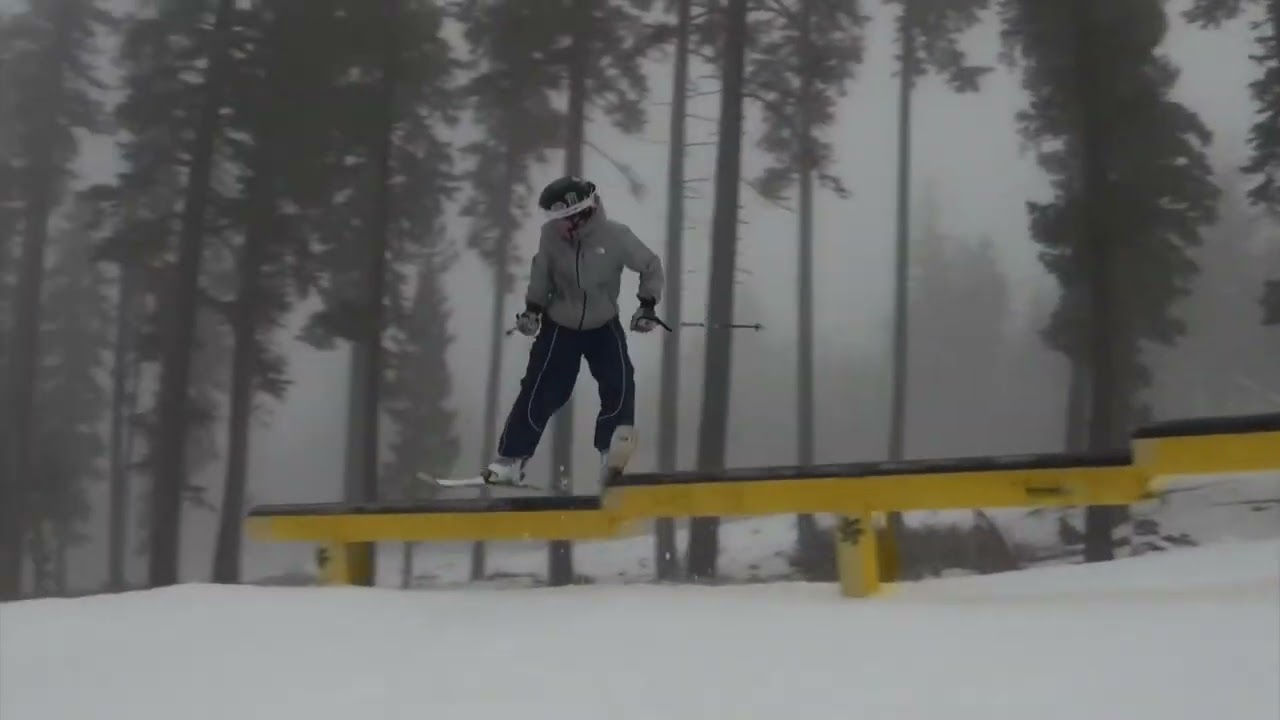
The official park programme identifies Sidewinder Burton Progression Park as the extra-small entry point. Moonshine moves riders into Small terrain, Pinball provides Medium features and Pipeline carries the Large designation. Northstar also maintains halfpipe infrastructure, historically including an 18-foot pipe and a mini-pipe. Jumps, boxes, jibs, rails, quarterpipes and natural transitions can all appear inside the freestyle network depending on the current build.
This structure is more important than a raw feature count. A new park skier can learn straight airs and box balance without sharing an approach with athletes carrying competition-level speed. As confidence increases, the next park introduces larger takeoffs, more technical rails and faster lines. Northstar's park safety programme explicitly reinforces this progression through the pre-ride, re-ride and freeride approach rather than encouraging riders to jump immediately into the largest terrain.
Pinball Rails And Pipeline Air Define The Technical Split
Pinball and Pipeline represent two different forms of freestyle progression. Pinball has historically concentrated a large amount of rail and jib terrain into a Medium-rated line where riders can work on technical combinations without needing the speed of the resort's biggest jumps. The repeated transitions between features make balance on exits important because one imperfect landing can affect the next approach immediately.
Pipeline moves the equation toward larger terrain. Its Large designation means greater feature dimensions, more consequential takeoffs and less margin for poor speed control. The presence of an 18-foot halfpipe has also given Northstar another technical training tool beyond slopestyle. Pipe skiing develops edge pressure, transition timing and aerial awareness through repeated wall hits, skills that transfer into large park jumps even though the movement pattern is different.
The Straits has historically carried some of Northstar's largest jump terrain, while Sidewinder, Moonshine and other zones fill the spaces between beginner progression and high-level features. Seasonal configurations can change, but the underlying concept remains one of Northstar's strongest advantages: freestyle is distributed through a network rather than compressed onto a single trail.
Northstar FIS Starts Feed The U S Freeski Pipeline
Northstar is not only a recreational terrain-park resort. Recent FIS slopestyle events have placed the mountain directly inside the American development pathway. Alex Bateman finished second in a FIS freeski slopestyle competition at Northstar on February 26 2025, giving him an important early podium before his later SuperUnknown success. The result shows the venue operating as a judged competition course rather than only a public park.
Hugh MacMenamin won a Northstar FIS slopestyle event in March 2023 during the build toward his international junior results. His pathway through Northstar, Junior Worlds and later U.S. development competition illustrates how Tahoe stops fit into the domestic freeski calendar. Athletes need more than one home mountain because contest preparation requires adapting to different rail sequences, jump speeds and snow surfaces.
Kainoa Pyle provides another example. His competition record includes both Northstar halfpipe and slopestyle starts, including a sixth-place FIS slopestyle result during the 2025 California competition block. That crossover between pipe and slope matches the structure of Northstar itself, where riders can train more than one park discipline inside the same resort.
Sebastian Kilgore has also competed at Northstar as part of a wider U.S. programme stretching through Mammoth, Woodward Park City, Copper and other national development venues. Northstar's significance therefore comes partly from where it sits inside that network: Tahoe athletes and travelling teams can use a full-scale public park system and then convert those laps into formal FIS competition runs.
The Backside And Lookout Add Trees Beyond The Park Map
Freestyle is the clearest Northstar signature, but 3170 acres give the mountain room for a different kind of skiing after a Sierra storm. The Backside and Lookout Mountain concentrate more advanced terrain, while multiple designated glades place riders inside the forest rather than on wide groomed pistes. The resort specifically highlights natural tree skiing as one of its mountain characteristics.
Northstar's gate-accessed terrain totals 347 acres when conditions and patrol status permit. These zones demand a different approach from the park. A rail line is shaped, inspected and designed around a visible landing; tree skiing contains buried obstacles, changing spacing and snow depth that varies through the forest. Riders should follow gate and patrol status rather than assuming fresh snow means every advanced zone is ready to open.
The tree terrain also gives freestyle skiers a place to apply park skills naturally. Quick edge changes, small drops, rollers and improvised side hits demand reaction rather than memorising a fixed course. That makes Northstar useful for riders who want a park-first resort without spending every hour inside constructed terrain.
350 Inches Of Sierra Snow Changes Park Speed Fast
Northstar publishes an average annual snowfall of 350 inches. Sierra storms can deliver dense snow in large bursts, creating a very different surface from the colder, lighter snow found in parts of the interior Rockies. That density can build a durable base quickly, but it also means park crews must manage major accumulations before features return to their intended shape.
California sun creates the opposite problem after storms. Takeoffs and landings can soften rapidly when clear weather returns, especially later in winter and spring. A jump that requires an aggressive approach in the morning may run significantly faster once the surface changes. Experienced riders therefore inspect the park repeatedly through the day rather than relying on the speed from an earlier lap.
Firm overnight conditions add another layer. Rails remain mechanically similar, but approaches, transitions and landings can become considerably less forgiving after a freeze. Northstar's progression system is particularly useful in those situations because riders can reduce feature size until the snow surface becomes predictable again.
Twenty Lifts Keep Park And Mountain Laps Moving
The lift network includes 20 installations across the mountain. Big Springs Gondola provides the main upload from the Village to mid-mountain, while high-speed chairs including Vista Express, Tahoe Zephyr Express and Comstock distribute riders toward Mt Pluto and the major terrain zones. Comstock has been upgraded to a high-speed six-person chair, improving circulation through one of the mountain's central sectors.
For park skiers, lift geometry affects training almost as much as feature quality. A technically good line loses much of its value if every lap requires a long traverse or multiple uploads. Northstar's central park network can be repeated efficiently while the wider lift system remains available for Backside, Lookout and groomed mileage when riders want to change objective.
The official winter 2026-2027 opening day is scheduled for November 20. Early-season terrain should still be treated separately from the resort's eventual full winter offering: park count, halfpipe status and advanced terrain depend on snowmaking, natural snowfall and shaping progress. Northstar's published ten-park figure describes the overall freestyle system, not a guarantee that every zone will be built on the first morning.
From Tahoe Competition Laps To Full Mountain Freeskiing
Northstar's freeski importance comes from the overlap between scale and specialisation. A resort with only a strong terrain park can become repetitive when snow is deep. A large mountain without progression-oriented park infrastructure can be poor for athletes trying to train technical tricks. Northstar combines 3170 acres, 100 trails and 2280 feet of vertical with a freestyle system that officially counts ten terrain parks and multiple feature sizes.
Its recent FIS record reinforces that role. Alex Bateman, Hugh MacMenamin, Kainoa Pyle and Sebastian Kilgore represent different stages of the American development pathway, yet all have competition connections to Northstar. That creates a direct line from public progression terrain to judged freeski events rather than separating recreational park culture from athlete development.
The mountain also offers enough terrain beyond freestyle to remain useful through changing Tahoe conditions. Park riders can move from Pinball rails to Pipeline jumps, advanced skiers can leave for the Backside or Lookout trees, and intermediate crews have enough groomed terrain to build speed control before entering larger features. With Mt Pluto at 8610 feet, 350 inches of average snow and the 2026-2027 winter beginning November 20, Northstar remains one of California's most complete park-first resorts without needing freestyle to be its only mountain identity.