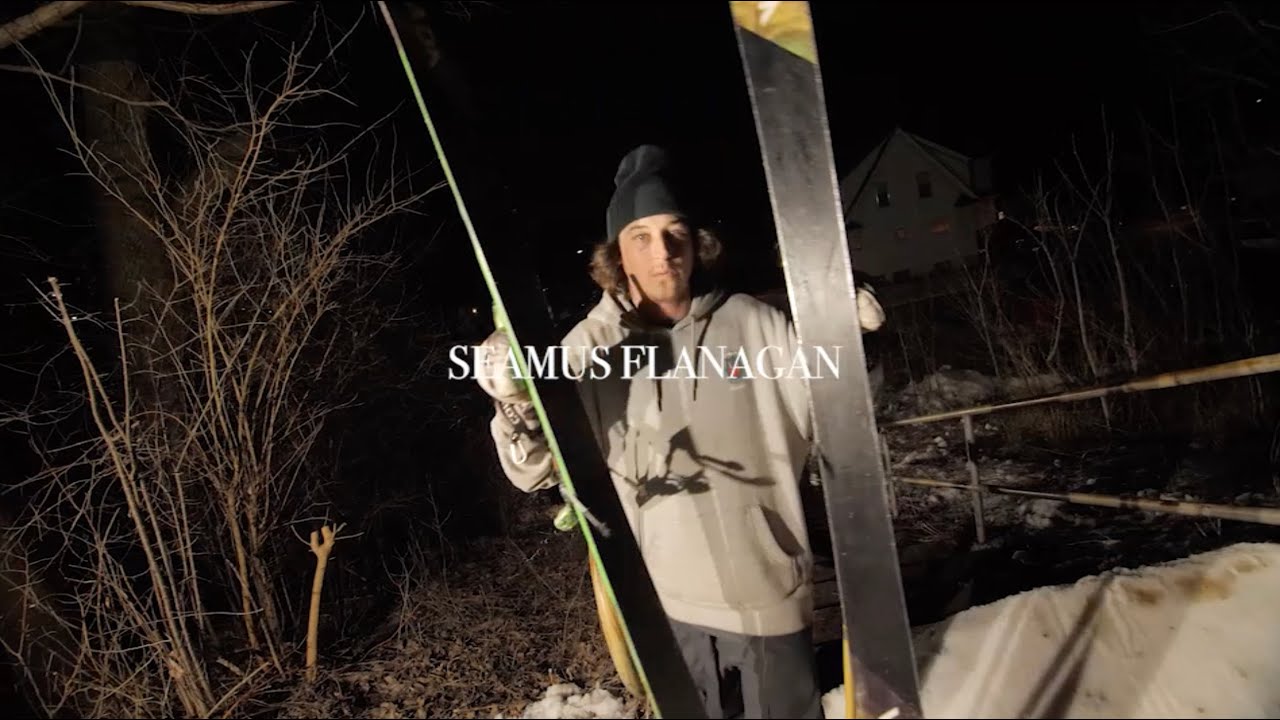
Seamus Flanagan
Colorado / Salt Lake City | Active Public Record: 2014-present | Known for: 70/30, Banged Up, SuperUnknown XVIII, Child Labor, Jiberish, street skiing | Current: Jiberish-linked park and street appearances
Duluth Concrete With Colorado Timing
The run-in in Duluth looked narrow, shoveled just enough for speed, with cold metal waiting at the end and a landing that did not care how many times the spot had been tested. Seamus Flanagan’s skiing belongs to that type of place: street rails, long drives, Midwest winters, Colorado park laps and crews that build a season clip by clip.
Flanagan is not publicly defined by World Cup podiums, X Games starts or an Olympic pathway. His record lives in the film-first side of freeskiing. FIS gives him a small official slopestyle history, but his real public profile comes through Jiberish street projects, SuperUnknown, Child Labor, and rail-heavy edits where style and spot choice matter more than formal results.
Rocky Mountain Freestyle On The FIS Sheet
FIS lists Seamus Flanagan as an American freestyle skier with Rocky Mountain Freestyle, born in 1996, status not active. His official results are limited to two 2014 slopestyle starts: a Nor-Am Cup at Aspen in February and a FIS event at Copper Mountain in December, both listed with 67th-place finishes.
That short record is useful because it shows an early contest-system entry point. It does not explain his later relevance. Like many American street skiers, Flanagan passed through the park and slopestyle framework before his public identity settled into urban filming, rail projects, Jiberish videos and the kind of skiing that travels through crews rather than national-team press releases.
Seventy-Thirty Across Four States
70/30 gave Flanagan one of his clearest early street-film credits. Jiberish described the project as a short urban film featuring Sam Zahner, Calvin Barrett, Mike Cappola and Seamus Flanagan, filmed, edited and produced by the riders. The locations included Colorado, Utah, Minnesota and New York City.
That description says a lot about the lane. The film was not a resort team edit or a contest recap. It was rider-made street skiing, built from travel, spot hunting, shoveling, filming and the willingness to turn city architecture into a skiable line. Flanagan’s name appears inside that small group, giving his profile a strong connection to late-2010s American street skiing.
Banged Up And The Cost Of A Winter
Banged Up followed 70/30 in 2018 and kept Flanagan in the same Jiberish-linked street circle. Newschoolers described it as an all-street ski film with Sam Zahner, Calvin Barrett, Mike Cappola, Seamus Flanagan, Scrappy Joe Young and Pete Koukov, filmed in Colorado, Minnesota and Massachusetts.
The title fits the process. Street skiing is often a winter of missed storms, bruised landings, blown-out takeoffs, security pressure and features that look better on maps than they do in person. Flanagan’s role in Banged Up places him in a crew that accepted that reality and still built a full film from it.
SuperUnknown XVIII At Woodward Eldora
In 2021, Level 1 selected Flanagan as a finalist for SuperUnknown XVIII, bringing him into the same field as riders such as Bennie Osnow, Luke O’Brien, Max Siudak, Oscar Weary, Danya Manyak and others. The finals were held at Woodward Eldora outside Boulder, Colorado, during a week of changing spring weather.
The event gave him a broader audience without forcing him into a conventional contest identity. Newschoolers’ recap noted that Flanagan stood out in the jump lineup with a seven and lead mute, then later landed a 3 swap on a rail-to-rail transfer gap. That combination fits his profile: enough park power to work on jumps, enough rail control to stay believable in street skiing.
Street Clips From Duluth To Denver
Flanagan’s own 2021 street clips listing gives a direct location thread: Duluth, Minnesota and Denver, Colorado. The filming credits include Alex Havey, Sam Zahner, Calvin Barrett and Ethan Timmons, with thanks to Armada Skis and Jiberish. That small note ties together the two forces around his public profile: trusted filmers and brands rooted in freestyle culture.
Duluth and Denver ask for different kinds of street skiing. Duluth brings cold Midwest rails, snow-covered urban features and harsh landings. Denver offers concrete, city rails, quick weather windows and a Front Range ski community close enough to the mountains to blur park and street habits. Flanagan’s clips sit between those worlds.
Why Not With Child Labor
Why Not? moved Flanagan into the Child Labor orbit. SBC Skier described the project as the crew’s fourth consecutive full-length street skiing video, filmed across northern North America in cities such as Minneapolis, Saint Paul, Pittsburgh and Québec City. The roster included Cal Carson, Andrew Egan, Bennie Osnow, Garrett Whaley, Sam Gnoza, Blake Rolfing, Thomas Stone, Dakota Connole, Seamus Flanagan, Joe Fusare, Zach Sturtevant and AJ Lefebvre.
That cast places Flanagan inside one of the strongest modern American street-skiing crews. Child Labor’s identity is blunt: rails, cities, cold winters, long drives and no need to dress the work up as something more polished. For a skier like Flanagan, that format is a natural match.
All In Good Time And The Rail Habit
Downdays listed Flanagan again in All In Good Time, another Child Labor project. The description framed the film as no-frills street skiing from a crew that likes rails: long ones, short ones, kinked ones, wooden ones, closeouts and the occasional ledge.
That wording gives the cleanest technical frame for Flanagan’s current archive. His skiing should be read through rail commitment, approach speed, line choice, compact body position, pressure through the feet and clean exits. The clips are not trying to imitate a slopestyle course. They are built around whether a feature, a trick and a camera angle can hold together.
How Flanagan Reads A Feature
Flanagan’s public skiing sits between park strength and street restraint. The SuperUnknown recap showed he could handle jumps and rail transfers, while the Jiberish and Child Labor films place him in harder urban settings. That range makes him more than a pure rail specialist, but the street credits remain the strongest part of the profile.
In his clips, the important details are practical. Watch whether the speed is honest, whether the takeoff looks rushed, whether the shoulders stay quiet on contact, whether the ski pressure holds through the rail, and whether the landing lets the clip finish cleanly. Street skiing exposes those details because there is no second feature to hide a mistake.
Jiberish From Copper To Big Sky
Flanagan’s Jiberish connection has stayed visible beyond the original 70/30 and Banged Up period. Recent Jiberish videos and media coverage list him in team settings at Woodward Copper for Jib League 2025 and at Big Sky in a Director’s Cut project with Jed Waters, Sam Zahner, Pete Koukov, Liam Baxter and local riders.
That continuity matters because it shows he did not disappear after one street cycle. His profile moved from full street films into broader Jiberish team appearances, park sessions, brand edits and crew-based projects. The same identity remains: rail-focused, low-ego, comfortable in groups where skiing and friendship are part of the same output.
Where Seamus Flanagan Fits Now
Seamus Flanagan’s profile is strongest when framed as American street skier, not as a contest athlete. The verified trail runs through FIS slopestyle starts, 70/30, Banged Up, SuperUnknown XVIII, his 2021 street clips, Why Not?, All In Good Time and recent Jiberish appearances.
For skipowd.tv, the accurate story is a skier shaped by Colorado parks, Midwest streets, Child Labor rail culture and Jiberish crews. His value comes from repeated presence in street projects, not from a medal table. Flanagan belongs to the layer of freeskiing where a long rail in a cold city can matter as much as any podium run.